Squad Helps Dog Bite Victim is the title of a 1980 compendium of unintended double-entendre headlines collected by the Columbia Journalism Review. It illustrates the power of tiny punctuation flubs — in this case, a missing hyphen — to radically alter meaning. Readers also have to chuckle in wonderment over how small a town must be for the local newspaper to deem dog bites newsworthy. When the dog is a coyote, however, and the person bitten is a 16-year-old girl in a National Park where a 19-year-old woman was killed by coyotes 10 months ago, there's no doubt about newsworthiness. Still, consider...

The US Transportation Safety Administration now keeps airspace safe from attack by snow globes, as well as toothpaste, mouthwash, and hair gel. A blog post by Patrick Smith, the airline pilot who posted this photo to his Flickr account, bores into the core irrationality of the phoney security restrictions citizens have acquiesced to since 9/11. Money quote: Conventional wisdom says the [9/11] terrorists exploited a weakness in airport security by smuggling aboard boxcutters. But conventional wisdom is wrong. What they actually exploited was a weakness in our mindset — a set of presumptions based on the decades-long track record of hijackings. In years...

The blobfish, highlighted in a New York Times slide show on ugly animals, is "practically all face — a pale, gelatinous deep-sea creature whose large-lipped, sad-sack expression seems to be melting toward the floor." An accompanying article explores the underpinnings of our aesthetic recoil: [C]omparative consideration of what we find freakish or unsettling in other species offers a fresh perspective on how we extract large amounts of visual information from a millisecond’s glance, and then spin, atomize and anthropomorphize that assessment into a revealing saga of ourselves. Wildlife biologists are far from immune to prejudice against the unbeautiful. [R]researchers found 1,855 papers about...

The Washington Post's Gene Weingarten longs for the way newspapers used to operate. On deadline, drunks with cigars wrote stories that were edited by constipated but knowledgeable people, then printed on paper by enormous machines operated by people with stupid hats and dirty faces. These days, by contrast: Every few days at The Washington Post, staffers get a notice like this: "Please welcome Dylan Feldman-Suarez, who will be joining the fact-integration team as a multiplatform idea triage specialist, reporting to the deputy director of word-flow management and video branding strategy. Dylan comes to us from the social media utilization division of Sikorsky Helicopters." Hat...

Reflecting on the Halifax Seaport Farmers' Market's opening day (previous posts here and here), Contrarian reader Jeff Pinhey writes: You are kidding me.  An American Homeland Security regulation, the one requiring a Port Security plan in all ports with ships leaving for a US port, causes that silliness?  Let me see, if I were a terrorist trying to sneak into Canada so I could board a ship bound for the states, and I could get as far as the waterfront in front of the market, I certainly could get as far as...

I described a 250-gigabyte laptop hard drive  as "impossibly huge." Ivan Smith found one twice as big at Tiger Direct: a 500 gigabyte Hitachi Travelstar laptop drive for just $99. That's 1¢ for every 50 megabytes. Ivan has more on the incredible shrinking price of data storage here....

The new Halifax Seaport Farmer's Market doesn't impress Contrarian reader Michael Graham: I really hope there is a tremendous amount of work to be done, because it is an insanely cramped space with two sets of narrow doors. There weren't thousands of people at once — no mob, just a very small space with no room to move. Three people effectively block all movement along an aisle — no wider than at a grocery store. Relatively speaking, the brewery market is incredibly easy to move through. What makes this space attractive? Glass, concrete, and gridlock? It's just a small warehouse with natural...

Give me your tired, your poor, your huddled masses, yearning to eat local: A huge throng of regulars, plus tire-kickers, overwhelmed the Halifax Seaport Farmers' Market's opening day this morning, forcing shoppers to wrestle with traffic tie-ups, inadequate parking, and impossibly long coffee lineups. It is a gorgeous space, however, and congestion will likely ease once construction is complete and the market starts opening throughout the week. Lead designer Keith Tufts, of the Halifax architectural firm Lydon Lynch, describes the building's advanced environmental features in this video. One sour note: US imposed, Homeland Security regulations prevent the market from opening the huge water-facing doors on...

Google CEO Eric Schmidt speaking at the Techonomy conference Wednesday: There was 5 exabytes of information created between the dawn of civilization through 2003, but that much information is now created every 2 days, and the pace is increasing...

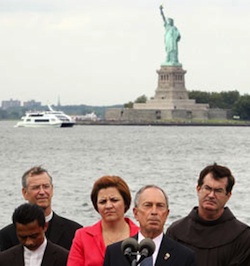
bloomberg_liberty-250New York City Mayor Michael Bloomberg's stirring defence of the Muslim community's right to build a mosque not far from the destroyed World Trade Centre is widely available on the Internet. But it embodies such rare eloquence in a principled, conservative defence of human freedoms and tolerance, it bears repeating here. First an excerpt:
We may not always agree with every one of our neighbors. That's life. And it's part of living in such a diverse and dense city. But we also recognize that part of being a New Yorker is living with your neighbors in mutual respect and tolerance. It was exactly that spirit of openness and acceptance that was attacked on 9/11, 2001. On that day, 3,000 people were killed because some murderous fanatics didn't want us to enjoy the freedoms to profess our own faiths, to speak our own minds, to follow our own dreams, and to live our own lives. Of all our precious freedoms, the most important may be the freedom to worship as we wish. And it is a freedom that even here -- in a city that is rooted in Dutch tolerance -- was hard-won over many years. In the mid-1650s, the small Jewish community living in lower Manhattan petitioned Dutch governor Peter Stuyvesant for the right to build a synagogue, and they were turned down. In 1657, when Stuyvesant also prohibited Quakers from holding meetings, a group of non-Quakers in Queens signed the Flushing Remonstrance, a petition in defense of the right of Quakers and others to freely practice their religion. It was perhaps the first formal political petition for religious freedom in the American colonies, and the organizer was thrown in jail and then banished from New Amsterdam.... This nation was founded on the principle that the government must never choose between religions or favor one over another. The World Trade Center site will forever hold a special place in our city, in our hearts. But we would be untrue to the best part of ourselves and who we are as New Yorkers and Americans if we said no to a mosque in lower Manhattan. Let us not forget that Muslims were among those murdered on 9/11, and that our Muslim neighbors grieved with us as New Yorkers and as Americans. We would betray our values and play into our enemies' hands if we were to treat Muslims differently than anyone else. In fact, to cave to popular sentiment would be to hand a victory to the terrorists, and we should not stand for that.
Watch the video here. After the jump, the full text of Bloomberg's speech.