Tagged: Nova Scotia
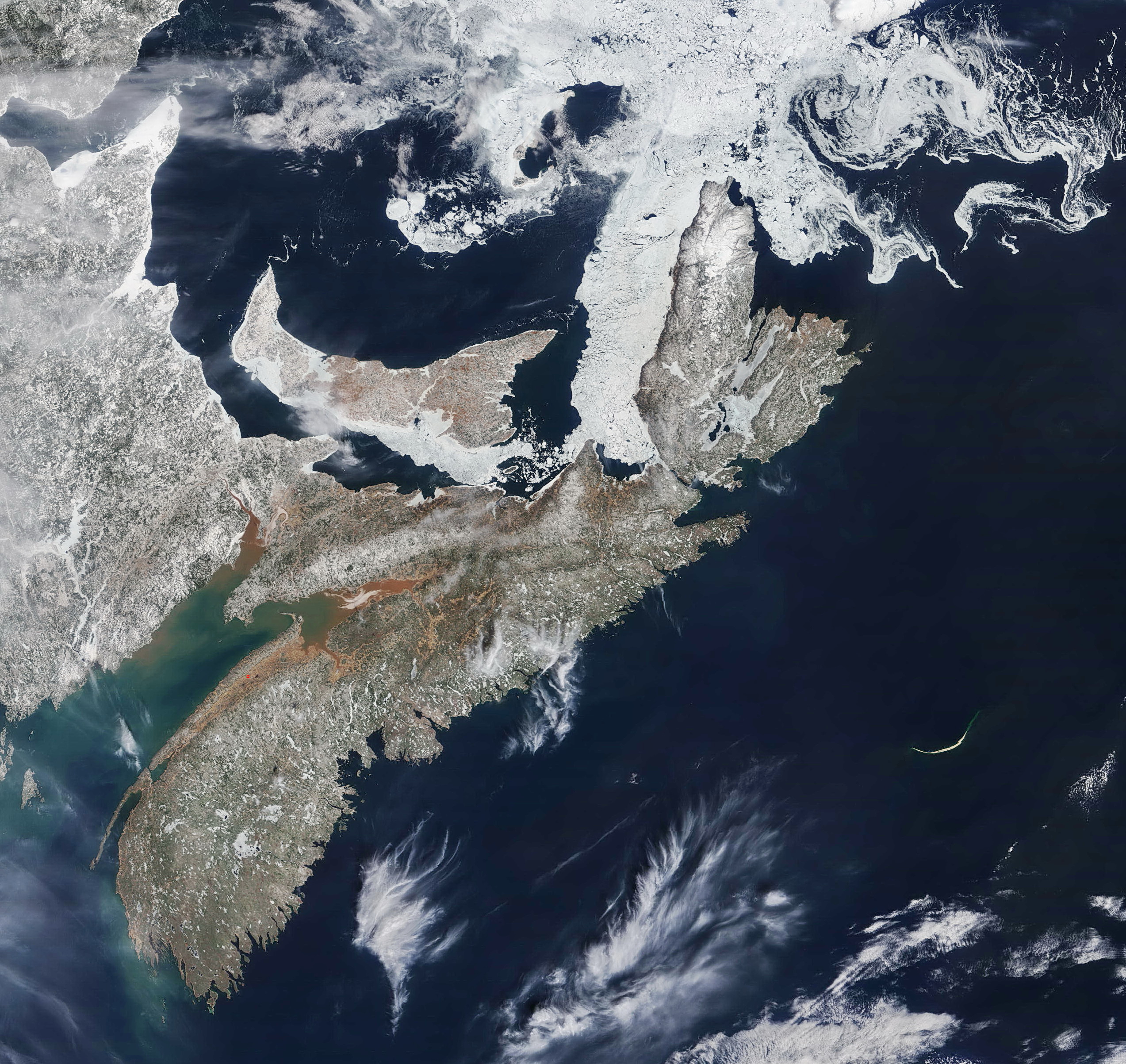
Nova Scotia weather
Ross Ferry resident Jeannie Ferguson puts April and May in perspective:
If Nova Scotia had better weather, we couldn’t afford to live here.
A most excellent time-wasting tool
That’s what Atlantic tech blogger Alexis Madrigal calls Google’s Books Ngram Viewer. Google has scanned about 10 percent of all the books ever published. Enter any word or phrase into the search box, and the viewer returns a graph of its frequency of appearance in books published over the last two centuries. Note that the searches are case sensitive, and you can compare the relative frequencies of up to four five different words or phrases, separating them by commas in the search box. Say, “Nova Scotia” and “Ontario,” for example:
Try it yourself, and please send me any interesting pairings you come up with.
Madrigal’s blog is always interesting, but today’s entries are exceptionally good. In addition to the Ngram Viewer, there’s a post on the history or weird homemade windmills that sprung up in Nebraska’s Platte River Valley during the last two decades of the 19th century, another on names for the movie projector that were tried and discarded before 1900, and an entry on the cautionary implications of the Stuxet virus for our industrial infrastructure, most especially the electrical grid. (Stuxnet is the worm that targeted a particular type of Siemens control system used to operate centrifuges critical to Iran’s nuclear program. The virus kept itself hidden until they day it instructed the centrifuges to spin so fast they purportedly self-destructed.)
Another reason to live in Nova Scotia
According to this crowd-sourced interactive graphic from priceofweed.com, Nova Scotia, New Brunswick, and PEI have the best retail reefer rates on the continent:
This is a screenshot. Click here to view the interactive chart, then click on any dollar sign to get data on that state or province. Detailed Nova Scotia price reports here. (Click any of the
Police reporters might want to bookmark this chart for ready reference next time the boys in blue claim the half dozen, half-grown plants they seized in Upper West Boot have a street value of 47 gazillion dollars.
Hattip: Floatingsheep.com.
Facing up to an unflattering mirror – Feedback, updated
Aside from a small issue of geography, reader Ivan Smith says the Globe and Mail’s take-out on racism in Nova Scotia, got it right.
The popular notion that racism has disappeared from Nova Scotia is just as wrong as that geography. Racism is still here. Not as bad as it was in the 1960s or even the 1980s, but we still have a long way to go.
How many Nova Scotians know that there were black slaves here?
Smith recommends Simon Schama’s Rough Crossings, a book and subsequent film depicting the treatment of blacks in Nova Scotia in the 1780s, available on DVD here.
A copy of that DVD should be available in every public library and school library in the province.
[Update]. Bob Collicutt reports:
There is one copy of Rough Crossings in the Halifax Regional Library system. As of 6:45 a.m. today there are 12 holds on it, including mine. Thanks to you & Ivan Smith for making us all aware of this film.
Facing up to an unflattering mirror – Update
In the wake of February’s cross-burning in Hants County, the Globe and Mail did what Nova Scotia newspapers ought to have done: assigned a top notch reporter to research and write a searching report on Nova Scotia’s unfinished history of racism. Many of you will have seen Les Perreaux’s piece when it appeared last month, but I missed it. He began by noting African Nova Scotia’s unique backstory:
[N]o other region on this side of the 49th parallel has Nova Scotia’s long history of a black-and-white divide. Until the immigration reforms of the 1960s, 37 per cent of Canadian blacks lived in Nova Scotia. Today, its black population of 19,200 is smaller than the numbers in each of the largest cities. But no other place in Canada has so many black communities still living in de facto segregation. Nowhere else in Canada does the legacy of slavery remain so tangible, as much as mainstream white society tries to block it out.
The remnants of that history can be as subtle as a suspicious glance in a corner store or the cavalier placement of a dog park or garbage dump on top of a poor community. At other times, racism flares up more dramatically, evoking places far south of Canada’s Ocean Playground.
Racism doesn’t disappear just because it’s no longer acceptable in polite company. On the contrary, the stigma that now attaches to racism may make it harder for white people to confront its influence. The unconscious syllogism goes something like this:
Then along come Shayne Howe’s neighbors.
The only black man in pastoral Poplar Grove in Hants County, Shayne Howe woke to the glare of that burning cross on his front lawn one night in February, while the perpetrators shouted threats and taunts. Then, last month, when one of the two brothers charged was due in court, the family car was torched, destroying the entire interior, including a new child-safety seat.
Sporting diamonds in his earlobes and a baseball cap perched on his head, Mr. Howe is a descendant of the original black settlers, Loyalists and ex-slaves who came to Nova Scotia in the 1780s. He mixes paint one sunny afternoon in their grey bungalow to prepare for the sale of his family’s house, which backs onto a vast, green hay field.
He’ll miss simple pleasures there, he says – riding his lawn mower, beer in hand, or skinny-dipping under cover of darkness in the backyard pool.
“I was comfortable before. People seemed okay with me,” says Mr. Howe, a 31-year-old truck driver, recalling his relief when a local shop owner stopped keeping watch on him whenever he dropped in for a carton of milk.
Because the alleged cross-burners are distant cousins of his wife, Michelle Lyon, many people around town dismiss the incident as a family feud. But Ms. Lyon says she had never met the brothers before.
A venomous Facebook page with more than 100 supporters has popped up to back one of the alleged firebugs, where residents of nearby Windsor and Halifax throw around the N-word while condemning the couple as publicity hounds.
The fatuous claim that the incident was just a family feud that got out of hand is an extreme example of white reluctance to acknowledge racism – even at the scene of a cross-burning.
Perreaux’s entire piece is worth a read.
[Update] Department of Amplification & Correction/
Reader Ivan Smith takes issue with Perreaux’s statement that, “No other region on this side of the 49th parallel has Nova Scotia’s long history of a black-and-white divide,” but not for the reason you might think.
Okay, maybe he meant it metaphorically. Nonetheless the geography is wrong. All of the Maritime Provinces lie south of the 48th parallel.
All of Nova Scotia, except for a tiny sliver at the far north end of Cape Breton Island, lies south of the 47th parallel.
Sandra Gittins of Truro points out that HRM’s mayor is of course Peter Kelly, not Peter Perry, as Perreaux calls him at one point.
What part of NS do tourists photograph?
Estonian travel buff Ahti Heinla used the distribution of photos on Panaramio to create a world heat map of touristiness. Yellow indicates high touristiness, red medium touristiness, and blue low touristiness. Areas having no Panoramio photos at all are grey. The analysis takes account of both the number photos and the number of authors in a given area. Here is a lo-res blowup of the Nova Scotia section.
What’s the difference between a “no queers” sign and a set of steps?
Haligonian Warren Reed has a sobering take on our discussion about potential “cures” for people with Down syndrome:
I am still stuck on the Down Syndrome thread. As Canadians with disabilities will tell you, Canada has a medical model of disability. The approach is, “let’s fix what’s wrong with you,” rather than, “let’s fix what’s wrong with us.” Hence the inaccessible buses, devilish sidewalks, and antediluvian building codes. The result is a hidden and large group of people who are disenfranchised, undervalued, ignored, and sometimes abused. See the shocking account in Monday’s Chronicle-Herald.
One of my big defeats was an unsuccessful complaint against poor building codes I made to the Nova Scotia Human Rights Commission in 2006. I thought it was pretty compelling, but the HRC are evidently a bunch of cowards who declined to get involved in improving lives.
I’m not disappointed anymore—just angry. Can you explain the difference between a “No Queers” sign and a set of steps confronting a wheelchair user? Chances are your local MLA maintains an inaccessible constituency office. A government that can’t include it’s most vulnerable citizens loses its moral authority.
This kind of systematic discrimination creates a climate where disabled people are second-class. Is it a surprise that they’re abused by those who should be protecting them? For people in wheelchairs and people with Down Syndrome Canada is a disappointing, dangerous place.
Simpson scopes the Labrador war
Jeffrey Simpson has a sensible column on NB Power’s proposed sale to Quebec Hydro, which he correctly portrays as the latest battle in the decades-old war between Newfoundland and Quebec. That’s a war in which Nova Scotia is no innocent bystander.
Simpson, who spoke in Baddeck Friday, can’t disguise his contempt for Danny Williams, the uppity colonial, but he has the broad strokes of the conflict right. He notes Ottawa’s “desperate” reluctance to intervene on behalf of the weaker party, a bit of realpolitik that might cause one to wonder whether Canada really is a country after all.


Sporting diamonds in his earlobes and a baseball cap perched on his head, Mr. Howe is a descendant of the original black settlers, Loyalists and ex-slaves who came to Nova Scotia in the 1780s. He mixes paint one sunny afternoon in their grey bungalow to prepare for the sale of his family’s house, which backs onto a vast, green hay field.