Category: Risk assessment
Culture gap

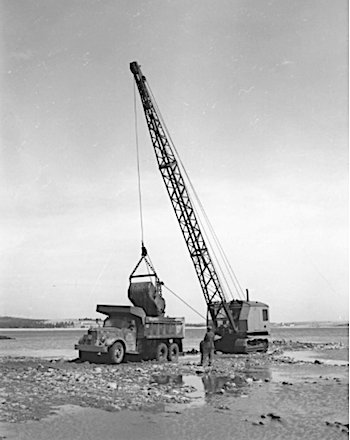
A Chinese engineer, on his first trip to the United States, a work assignment for his company, snapped this photo, reproduced today on James Fallows’s blog. Fallows asks his readers:
- Why did he take the photo?
- What happened next?
For the answers, go here.
Yachts, tight squeezes, and rust in the eye
The video of a clever mariner squeezing his 80-foot mast under a ’65 bridge on the Inter-Coastal Waterway reminded Chris Lambie of sailing across Florida’s Lake Okeechobee with his father.
We weren’t sure if our mast would clear a bridge on the eastern edge of the lake, as the water level was pretty high. But my dad did the calculations and figured we’d squeak through. As we slipped underneath the span, the VHF antenna ticked gently against one of the girders, and dad got a speck of rust in his eye.
I also remember running gently aground somewhere in the silt that collects everywhere on the southern end of the Inter-Coastal Waterway. I hung off the boom—which we cranked out as if we were on a dead run—to tilt the boat to starboard. My dad then jumped in the water and pushed us out of the soft mud. Not as much fun as it sounds, as we saw lots of water moccasins and alligators in that portion of the trip.
I’m just thankful Chris wasn’t in a kayak.

Shaming without evidence: readers respond
On Sunday, I questioned the sudden closure of the Talbot House Recovery Centre, and the treatment accorded it’s executive director, Fr. Paul Abbass, after a victim’s rights activist apparently passed along an unspecified third- or fourth-party complaint about Abbass to the Department of Community Services.
A sample of the responses follows, but please also see this clarification of my original post.
A reader writes:
I am a former resident of Talbot house and I am convinced the experience saved my life. At no time during my therapy did I witness any impropriety on the part of Paul Abbass or any staff member. Talbot House has been a place of healing for many, for many years.
Ed Murphy, retired director of the St. Francis Xavier Extension office in Sydney, writes:
I’ve known this guy a long time, and I’ve been a long-time admirer of the work of Talbot House. I’m so pissed about the way this has been handled. Thanks for doing something when the rest of us do nothing.
A former parishioner of St. Andrew’s Church, Boisdale, where Father Paul Abbass was the parish priest, writes from Ontario:
I am in total agreement with your article. Innocent till proven guilty… Everyone has a right to confront their accuser, and Fr. Abbass is no less entitled.
A Halifax resident who calls Beaver Cove home writes:
Although I did not have the opportunity to get to know him very well, people whose opinion I value speak very highly of him. Furthermore, based on my limited interaction with him, I, too, found him to be a good and spiritual person.
If Father Abbass is guilty of impropriety, particularly in light of the recent events in the diocese, then this is very alarming and the church in this area may be damaged beyond repair.
Furthermore, Father Abbass will have to take responsibility for his actions.
However, what worries me as much is: What happens if the allegations are not criminal and he is innocent? The people at the Department of Community Services and the Board at Talbot house will have to explain to the public and to the parishioners how they plan to put this genie back in the bottle.
Father Abbass has already been dealt with as if he is guilty, losing all positions of trust. While this is appropriate, it places a great deal of responsibility on those who are investigating the allegations. They must be expeditious yet diligent.
What worries me is that the department’s responsibility to be expeditious may not be considered important. If the allegations are ultimately unfounded, Father Abbass’s reputation will be none the less harmed. If so, I hope the press will demand that the department explain in clear terms why the investigation took as long as it has.
A former board member of Talbot House, whose son was treated there, writes:
My son spent the better part of a year there, continued his education, remains sober and works full time. He did all the work. Talbot House was the perfect supportive setting.
I sent Father Paul an email when I read about the allegations. I told him that I believe in him and all his goodness. I still do.
I was crushed to hear the place was closed so quickly. I don’t know why, and have not talked with any board members or staff. I wish this investigation would shed some light not only on the allegations, but on Talbot House’s effectiveness. I believe it will stand up to scrutiny.
Talbot House was designed around the belief that an addicted person can recover and rebuild a life.
That approach conflicts with other provincial facilities, which seem to be more about preventing harm to society than helping someone who is sick. That’s my biased view. And don’t get me started on the ridiculous policy of only opening the door to treatment if the sick person quits cigarettes too.
Questions should be asked about Talbot House’s premature demise. It happened too quickly and without explanation. Those questions aren’t likely to be asked by sick people who struggle to cope with recovery from addiction.
Teresa MacNeil, former Chair of the Cape Breton Development Corporation, Vice-Chair of Enterprise Cape Breton, and director of Extension at St. FX, writes:
Thank you for so clearly articulating the essential features of the shoddy treatment of one who deserves open and just treatment. Actually every accused person deserves that much.
I have been aware of Father Paul Abbass’s work over the years, especially when he was located in Antigonish and new Glasgow; always characterized by a high level of service, concern, dedication, commitment. It is entirely unacceptable to allow him to be quietly banished without open and just attention to the complaint that forced him to “step down.”
Thanks to all who wrote.
Reining in environmental assessments
Here’s another placemarker for an issue I’ve wanted to write about for some time. I have not read any details of the Harper Governments plan to rein in federal environmental assessments, but in principle, I believe such an exercise is long overdue.
It is a dirty little secret of the environmental movement that federal environmental assessments are a massive scam. They take far too long. They cost far too much. They do not focus on important issues.
Everyone in the system knows this, but no one complains, because almost everyone benefits. Engineering companies get tens of millions of dollars to carry out the studies; environmental groups get hundreds of thousands in baksheesh for their participation; the Environment Canada and the Canadian Environmental Assessment Agency get a level of featherbedding that would make John L. Lewis blush. The process does little to protect the environment that a much simpler, more focused approach could not do better and more efficiently.
‘Fraidy cat province: Strait-Richmond edition
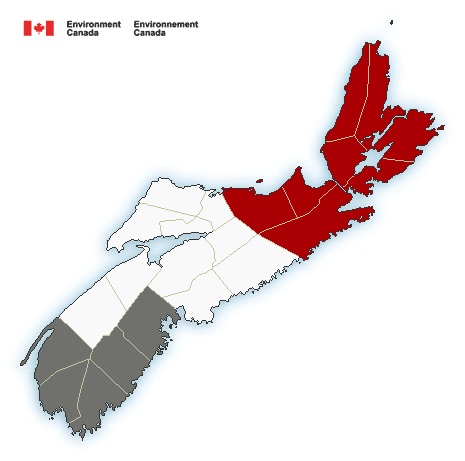
The Strait-Richmond Regional School Board cancelled classes in all schools today. Apparently there’s a wicked storm underway.


Thank God the children are safe. Not to mention the teachers and board administrators, union members all, right up to the superintendent.
To be fair, there is snow visible in half of these highway cam images from the school board’s catchment area, just none on the actual roads beings monitored. In case you missed Jim Meek’s column on this subject in Saturday’s Herald, you can find it here. Said Meek:
My idea of hell is [CBC weather dude Peter] Coade broadcasting the weather forecast in an endless loop on TV, which is pretty well what CBC Nova Scotia passes off as news these days. (Just add in crime, and you’ve got the formula.)
It’s not that I have anything against Coade, a good man stuck in an assembly line job. It’s just that we have now endured months of warnings about weather bombs that never exploded; slippery roads that didn’t materialize; and storm forecasts that yielded to sunny days.
What will it take to restore some common sense to these decisions?
The snow day debate continues

Too damned many.
In response to my note about the 40-something Norwegian who had never seen a snow day until he came to Nova Scotia, Contrarian reader Joyce Rankin of Mabou Westmount blames consolidation of schools and secularization of society for the proliferation of snow days. Her response sparked a lively email debate.
I remember we never used to have snow days either. But then again, we were close enough to school that we could walk.
The questions to ask, for a proper comparison, would be how far children in Norway travel to school, and how far people drive to work, and over what kind of roads? And if there’s not an official snow day, does that mean that everyone shows up? Or does it mean that those who can make it come and the place functions (or not) with a skeleton crew, accomplishing little.

You can drive in this.
All valid points. But it could also be there that Norwegians are just a little less timid about driving when there is half an inch of snow? We do have snow tires after all. This implies that driving on snow is something we do.
Why doesn’t Alberta have snow days? We have too many damn snow days. I hear it from everyone.
It’s not so much snow that’s the problem, but rather ice. In Alberta it tends to get cold and stay cold, and it is not as wet. Not so much temperature fluctuation and hence less ice. Plus in areas where it’s flatter and the roads are straighter, the driving is easier. (Note that the accident often happen at curves and hills.)
I’m not disagreeing that it gets a bit silly sometimes. But the school board is to blame, too, because the new procedure is for the board superintendent to make the call for the whole district, rather than the principal making it for each school. I guess they haven’t noticed the variation in weather from, say, Ingonish to Sydney River to Louisbourg, or from Pleasant Bay to Louisdale to Canso to Antigonish.
Plus it’s because of liability. Administration is afraid that someone will get hurt and they’ll get sued for making them come to work.

Birds do it. Squirrels do it. Even bright yellow buses do it.
I take your point about one-size fits all in boards that stretch over a huge territory. But I think the issue shows a problem with the way society handles small risks of terrible outcomes. We place policy makers in an invidious position. They might be criticized for over caution, but they would be savaged if a child is injured or killed. But life is not risk free.
This issue also dovetails with another bugaboo of mine: the fact that too many school system managers, up to and including superintendents, are in the teachers’ union. Unions should not be given the task of deciding when a day off is appropriate.
The bottom line is that we have far too many snow days in NS. We have snow days where there is barely any snow. We have snow days on days we would not have given a second thought 15 years ago. It has crept up on us, and it has gone too far.
I have driven long distances on bad roads to work, and I have worked in places where there’s a lot of pressure to be at work no matter what (and where you don’t get paid if you don’t come in).
It would be interesting to compare accident stats –was there a larger percentage of serious accidents and fatalities when people were more willing to drive on icy roads? I’m guessing yes.

Some wintry jurisdictions keep on bussin'.
While you’re at it, compare snow-day attendance at Nova Scotia ski hills compared to weekdays when schools remain open.
I think one of the results of secularization is that people value themselves and their physical well-being more than they used to. We expect to have control over our lives. We have less of the kind of humility that a) leaves it up to God or to fate, and b) views oneself as only one of many. We have learned to expect that we should be taken care of and insulated from risk. Most workplaces are much safer than they used to be, fewer people work outdoors, and there’s less call to be tough and resilient. (Which probably explains the rise of extreme sports -these are the people who in another century would have gone to sea or been a trapper or something.)
We expect things to be okay, we see it as an entitlement. And when something does go wrong, we want to blame it on someone. People in administration know this, and they don’t want to be the one blamed.
The giftie gie us
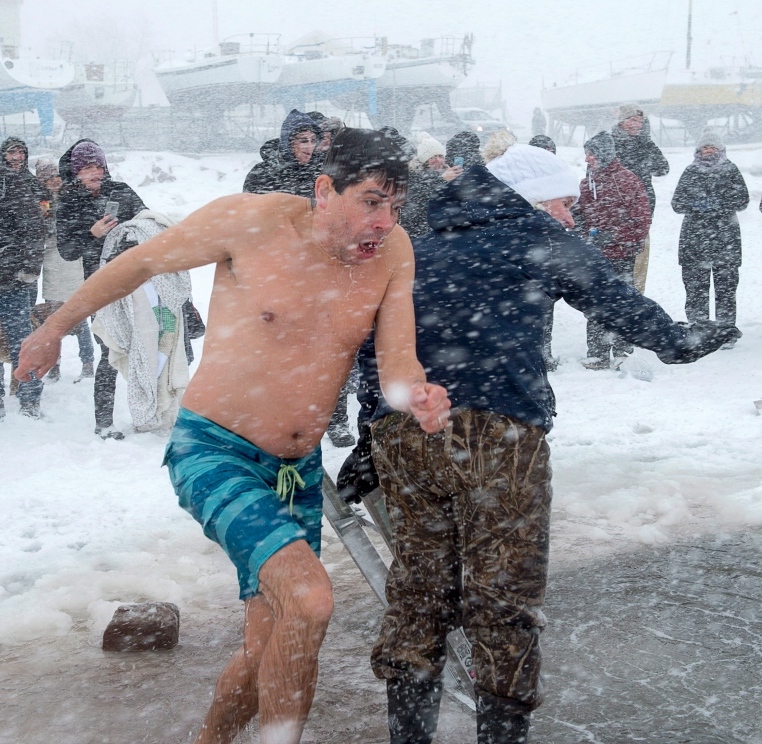
I met a Norwegian immigrant last night, a man in his 40s. He has lived in Nova Scotia for four years. At one point, the conversation turned to snow days.
“You know,” he said, “in 40 years in Norway, I never saw one snow day. Not from school. Not from work.”
Four years in Nova Scotia, and he’s seen about 40.
Just saying’.
A tale of two shipwrecks
One in Brittany, France, the other in Cape Breton, Canada. One cleaned up in a month, the other untouched after four, with no cleanup in sight.
Here’s the TK Bremen shortly after it grounded on Kerminihy Beach, near Erdeven, Brittany, France, on December 11. 2011.

And here’s the M/V Miner after it grounded on Scatarie Island, Cape Breton, after a towing cable parted on September 14, 2011.

The much larger Miner was under tow, bound for a scrapyard in Aliaga, Turkey. Here are the two ships’ specifications:
| M/V Miner | TK Bremen | |
| Launched | 1965 | 1982 |
| Type | Bulk carrier | General cargo & bulk carrier |
| Built in | Quebec, Canada | Pusan, South Korea |
| Length (LOA) | 222.5 m | 109 m |
| Beam | 23 m | 16 m |
| Draught | 8.2 m | 6.74 m |
| Gross tonnage | 17,831 | 3,992 |
| power | 8,000 bhp | 4,000 bhp |
| Shipwrecked on | Sept 20, 2011 | Dec 16, 2011 |
| Shipwrecked at | Scatarie Island, Cape Breton, Nova Scotia, Canada | Kerminihy Beach, Erdeven, Brittany, France |
| Flag | * | Malta |
| Owner | Pella Shipping Co., Thessaloniki, Greece | Blue Atlantic Shipping Ltd., Malta |
The Bremen was much more accessible than the Miner, having grounded on a mainland beach, while the Miner fetched up on remote, unpopulated, forbidding Scatarie Island. Though very different, the two areas share one thing in common besides shipwrecks: The dunes adjacent to Kerminihy Beach are a nature preserve, and Scatarie is a provincially protected wilderness area.
There the similarities end. As detailed in a photo spread on TheAtlantic.com website, 40 men worked day and night for two weeks to dismantle the Bremen and clean up the beach, at a cost of nearly €10 million euros (CDN$13.2 million).
“One month after the wreck,” reports The Atlantic, “the cleanup process is nearly complete.”
The French cleanup began:

The work continued:

Here’s all that remained of the TK Bremen as of Monday:

I won’t attempt to draw any lessons. I’m no expert, and the Miner is a much larger vessel in a much dicier location. But it may be worth noting that three weeks after the Miner went aground, NS Premier Darrell Dexter hadn’t been able to get any federal agency to take charge of the disaster. And I can’t recall any Canadian shipwreck being cleaned up the way France cleaned up the Bremen, let alone in two weeks flat.
Makes you wonder.
The website Boatnerd.com details numerous collisions, groundings, and accidents experienced by the Miner its previous incarnations as the Canadian Miner, the LeMoyne, and the Maplecliffe Hall. More information about the Miner here and here, and about the Bremen here, here, and here.
* According to Boatnerd, the Miner’s Canadian registry was cancelled last June. I was unable to determine its registry for the aborted trip to Turkey.
Donham’s Law of Fisheries Conservation reconfirmed
In an almost perfect illustration of Donham’s Law, the New York Times reports this morning that New English fishermen are pooh-poohing calls from fisheries scientists for greater restrictions, or even an outright ban, on cod fishing in the gulf of Maine.
The scientists point to new data showing cod stocks in much worse shape than previously thought; the fishermen say there’s an abundance of fish.
“Fishermen will almost always tell you that, and it’s not that they’re lying,” said Mark Kurlansky, whose 1997 book, “Cod: A Biography of the Fish That Changed the World,” documented how Canada’s once-abundant Atlantic cod were fished almost to extinction. “Landing a lot of fish can mean the fish are very plentiful, or it can mean the fishermen are extremely efficient in scooping up every last one of them.”
Donham’s Law of Fisheries Conservation states that All fishermen resolutely support conservation measures, except those targeting the species they fish for, and the gear types they fish with.