
19 Jul Fear of flying over the Ukraine
James Fallows has a couple of great pieces, here and here, on why the world should not blame Malaysia Airlines for flying over the eastern Ukraine while hostilities were underway 33,000 feet below. The nub of his argument is that restrictions on flight routes are rightly and necessarily the province of governments not airlines, and Flight 17 rigorously observed the limited restrictions governments had laid down—the equivalent of driving 63 mph in a 65 mph zone.
Equally important, “[A]ir transportation, like most other modern systems, could not operate if it fortified itself against every conceivable peril.” This is a lesson we forgot in the wake of 9/11, which is why a single attempted shoe bombing led to a decade of shoes-off orders.
The failure understand this essential fact of life—that we cannot achieve zero risk in any aspect of our existence—is one of the major problems facing contemporary society. Among many other things, it’s why young women and men arrive at university having never made an autonomous decision about their personal safety. It’s why we’re outraged to discover that the second worst hurricane to strike Nova Scotia in 100 years produced power and telephone outages that lasted more than a few hours. It’s why the CBC and other broadcasters debase their journalistic standards with exaggerated warnings about trivial weather events, urging us to stay in our beds with the covers drawn up at the first sign of flurries. It’s why we suddenly have 10-20 snow days a year in a province where children had previously made their way to school in snowstorms for 100 uneventful years.
Fallows includes this useful chart from Spiegel showing the number of flights by various airlines in the week before Malaysia Airlines flight 17 was shot down:
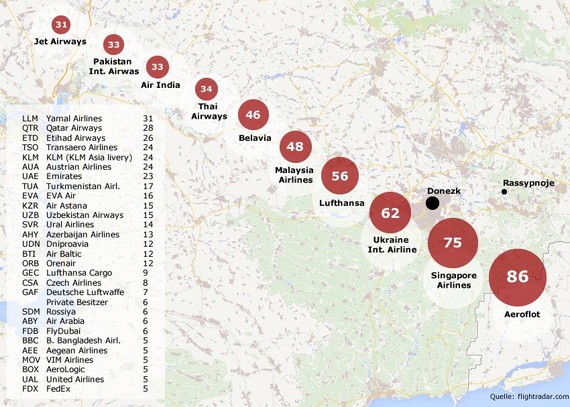
Malaysia Airlines was in the middle of the pack.