
25 Jul Cancer rates in Pictou County — last word
In two recent posts, here and here, I expressed doubt about a Herald columnist’s contention that Pictou has the highest cancer rates in NS, and the noxious Northern Pulp mill might be responsible. Several readers pointed out that recent figures on cancer rates by county and by district health authority are available at Cancer Care Nova Scotia’s website. The results do not support the claim that Pictou residents suffer from “the highest cancer rates in Nova Scotia.”
Here is the 2010 incidence of all cancers per 100,000 people for Nova Scotia’s 18 counties:

Women in Pictou had the sixth highest overall cancer rate out of 18 counties; Pictou men had the 13th highest.
Ranked by health district, Pictou women were the fifth highest out of nine, and just slightly above the provincial average; Pictou men were eighth out of nine, and well below the provincial average:
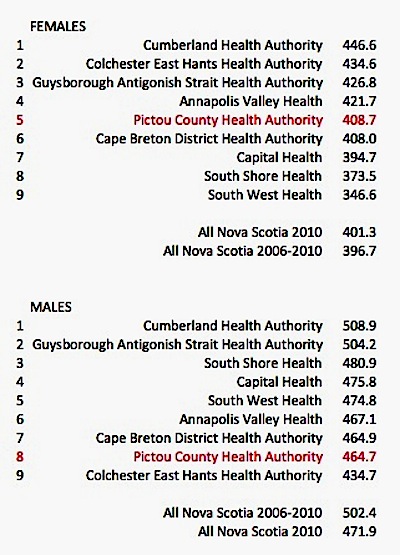
Cancer stats need to be interpreted with care. There is a rich trove of information in the 2014 edition of Canadian Cancer Statistics, a 132-page report by Canadian Cancer Statistics Advisory Committee, an arm of the Canadian Cancer Society. The report also offers important cautions about how to interpret the data:
Geographic variations in incidence rates may be due to differences in modifiable risk factors, such as unhealthy diet, smoking, obesity and physical inactivity. Differences in incidence rates may also be related to different provincial or territorial programs or procedures for the diagnosis and early detection of cancer, such as approved screening programs and the availability of diagnostic services. Other factors may impact the interpretation of variations in projected rates among the provinces, including the following:
- Cancer frequency – When a cancer is rare or the population is small, the estimated number of new cases of a cancer type may be subject to greater statistical variation.
- Cancer registration method – While the registration of new cancer cases is generally very good across the country, there are exceptions. Incomplete registration is mainly linked to the unavailability and inaccuracy of death certificate data and specific diagnostic information in some provinces.
- Method of projection – The selected method of projection (Nordpred Power5 regression model or five-year average) for provincial data can vary across provinces and across cancer types (see Tables A12 and A13 in Appendix II: Data sources and methods).
- Availability of in situ cases – The large variation seen in bladder cancer incidence rates among the provinces is likely due to differences in reporting of in situ cases, especially in Ontario, where such cases were not collected until recently and were not available for this publication.
Or put another way, best not to sling around anecdotal claims about a widely feared disease when trying to build a case against an environmental scourge, however nasty.
Disclaimer: The Northern Pulp plant is, was, and always has been an environmental scourge, and a shameful example of racism and politics at its worst. But there’s no evidence it’s causing cancer in Pictou County.