
10 Sep Starving slaves out on Scatarie
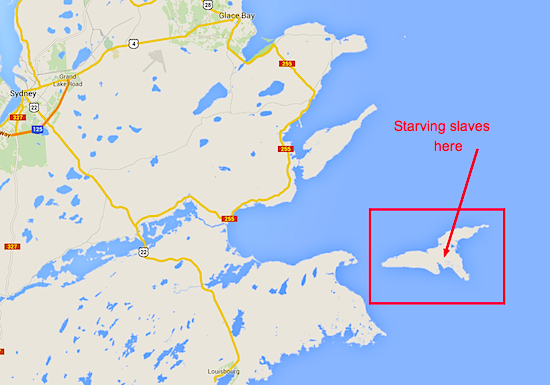
Over at the Halifax Examiner, Tim Bousquet has a brief discussion on the history and extent of slavery in Nova Scotia, with links to an interesting monograph, images of ads from Halifax newspapers seeking the return of slaves who escaped from their Nova Scotia owners, and a book that touches on the subject.
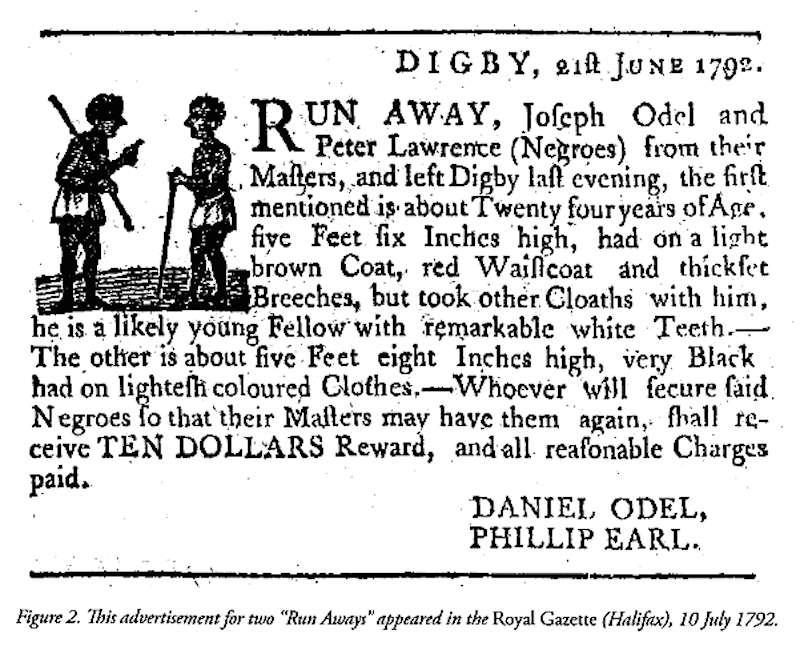
(Click image for larger version)
When I first came to Nova Scotia, I spent time with older neighbours on Boularderie Island, many of whom were great storytellers and singers. One man, Donald MacDonald, known as Donald Bugle, a native Gaelic speaker, sang a song with a verse that went something like this:
Alex Angus* and Roddie Hector*
The cutest shavers you e’er did see
Spearing eels in the month of April
And starving slaves out on Scatarie
(* I have made up the names of the two “cutest shavers,” because I can’t recall them, but I am certain they took the familiar double-barrelled Cape Breton format: child’s first name followed by father’s first name.)
As a Yankee newcomer to Cape Breton, I knew my homeland had a history of slaveholding. But I wondered what the heck slaves might have been doing on Scatarie Island, a patch of scrub off Main-A-Dieu inhabited by lighthouse keepers and few others. No one I talked to had any idea. The puzzle has lodged in my mind ever since.
About 10 years after I heard Donald Bugle sing that verse, the Cape Breton singer-songwriter Ronnie MacEachern recorded Amby Thomas of Deep Cove (a hamlet between Main-A-Dieu and Port Morien) singing a nearly identical verse as part of a mining song called, “When I First Went to Caledonia.” Listen to the third verse.
It was I and my brother Charlie
The biggest shavers you ever did see
Were spearing eels in the month of April
And starving slaves out on Scaterie.
The rest of the song is not the one I heard Donald Bugle sing in the late 1960s, but then, clever lyrics often migrate from song to song in the folk tradition.
The English folksinger Norma Waterson discovered “When I First Went To Caledonia” in Songs and Stories from Deep Cove, Cape Breton, a book MacEachern and Thomas published in 1979. She recorded it on her 1994 album, Waterson:Carthy. In her hands, the simple air, apparently borrowed from a Gaelic song, “Mo Ruin Gael Dileas,” takes on what one writer called, “a hymn-like quality… washed through with something more intimate, reminiscent of the bittersweet love songs [of] Kate and Anna McGarrigle.”
(For non-Cape Bretoners, “Caledonia” is a neighbourhood in Glace Bay, and “No. 3” was a pit—a coal mine—in that town.)
There are so many interesting nuggets in this song:
- There’s the reference to Boularderie Island, Donald Bugle’s home, which Thomas pronounces Bowlandarry, a common variant at the time, and which Waterson can’t pronounce at all.
- There’s Thomas’s correct use of the subjunctive voice (“I wish I were but I wish in vain / I wish I were a young maid again”).
- There’s the unexplained change from an old woman singing in first person, to a young coal miner singing in first person (probably the result of verses borrowed from other songs).
- There’s Donald Norman’s daughter, “who could make good tea.”
- There’s the uncannily accurate social history inherent in “coming to Caledonia and getting a loading at No. 3.”
Before the Steel plant opened in 1901, and the coal mines ramped up to supply it, the four counties of Cape Breton had roughly equal populations. The plant and the mines sucked young men off the farms of Inverness, Victoria, and Richmond. The story of coming to Caledonia (or somewhere like it) and getting on at No. 3 (or No. 12, or No. 26, or Princess) was repeated hundreds of times at a dozen pits. Cape Breton soon ran out of farm boys. By 1921, the British Empire Steel Company, which controlled the entire Sydney coal field, was recruiting all over the world, which is how Whitney Pier came to be one of the most multi-cultural communities in Canada.
This still leaves the perplexing business of the starving slaves out on Scatarie. Was the singer bemoaning the impoverished circumstances he and and his brother found themselves in, “like starving slaves out on Scatarie,” with “like” having somehow morphed to “and?” That’s not how I hear it, but if this was the singer’s intent, how on earth would he come up with a phrase like, “starving slaves out on Scatarie?” It seems exceedingly unlikely that a lightkeeper’s family would have kept slaves on the island. Had slaves perhaps been shipwrecked on Scatarie at some point during the Middle Passage?
I offer this thesis topic to history grad students among Contrarian’s readers. You can find several variants of the song on line. Here are the lyrics as Amby Thomas sang them.
WHEN I FIRST I WENT TO CALEDONIA
I wish I were but I wish in vain
I wish I were a young maid again.
A young maid again I will never be
‘Til an orange grows on an apple tree.When I first went to Caledonia
I got loading at No. 3
And I got boarding at Donald Norman’s
He had a daughter could make good tea.It was I and my brother Charlie
The biggest shavers you ever did see
Were spearing eels in the month of April
And starving slaves out on Scaterie.I went to Norman’s for a pair of brochans
A cake of soap and a pound of tea
But Norman told me he wouldn’t give them
Till fish got plenty in Scaterie.I went over to their Big Harbour
Just on purpose to see the spray
I spied a maiden from Boularderie over
I surely thought her the Queen of May.I wish I were on the deepest ocean
As far from land that once I could see
A-sailing over the deepest ocean
Where woman’s love would not trouble me.I’d lay my head on a cask of brandy
And it’s dandy I do declare
For when I’m drinking I’m always thinking
How can I gain that young lady fair.If I had pen from Pennsylvania
If I had paper of truly white
If I had ink of the rosy morning
A true love’s promise to you I’d write.