
14 Feb Is the ‘terrorist’ label ever useful?
When word of the foiled Valentine’s Day shooting plot emerged, along with police assurances that it was not a terrorist attack, I tweeted:
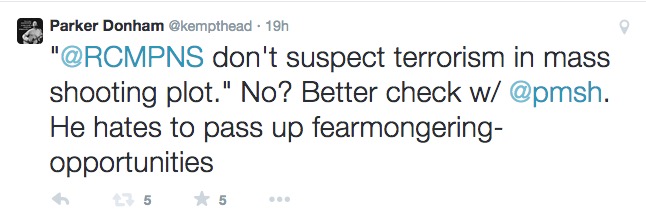
This was tounge-in-cheek, of course, I was happy to have police debunk any terreorist connection, because I thought doing so might curb the Harper Government’s penchant for ramping up public fear of violence at every opportunity.
I was wrong. As if on cue, Justice Minister Peter MacKay called a news conference to trumpet the events as justification for existing and proposed government surveillance of private citizen communications. In fact, as the police made clear, spying on citizens played no role. An unknown tipster alerted police to the plot.
This is consistent with what we already know about massive spying on citizens by the US National Security Agency. Claims that NSA spying stopped terrorist plots have been thoroughly debunked.
Writing in the Halifax Examiner, Tim Bousquet took the opposite tack on terror. He wondered why the prospect of four young people shooting up a crowded shopping centre with the goal of killing as many as possible doesn’t qualify as terrorism.
Limiting the definition of “terrorism” to only “scary shit done by radical Islamists” serves a social function. Namely, it allows the scary Islamists—a foreign, impossible-to-understand “other” that has nothing to do with our society—to be used for political purpose, an excuse to restrict civil liberties in the name of vigilance and safety….
School shootings, mall mayhem, and other mass murder events at the hands of our fellow citizens have been with us for decades, if not centuries, and yet we’ve not allowed them to cloud our judgment. We’ve recognized them for what they are: horrible events, yes, terrorizing events, yes, but exceptions to our common day-to-day experience, not something that should stand in the way of a free and open society, a democratic society that values privacy and even unpopular dissent.
The lesson here is that we should all—journalists most of all—be wary of fright-words like “terrorist” and “Islamist.” Roy Peter Clark of the Poynter Institute, offers a list of questions that can guide our understanding and use of such terms:
- What is the literal meaning of the questionable word or phrase?
- Does that word or phrase have any connotations, that is, associations that are positive or negative?
- How does the word correspond to what is actually happening on the ground?
- What group (sometimes called a “discourse community”) favors one locution over another, and why?
- Is the word or phrase “loaded”? How far does it steer us from neutral?
- Does the word or phrase help me see, or does it prevent me from seeing?
Clark quotes in full from a memo from Al Jazeera editor Carlos Van Meek reminding its reporter4s to avoid loaded words:
We manage our words carefully around here. So I’d like to bring to your attention some key words that have a tendency of tripping us up. This is straight out of our Style Guide. All media outlets have one of those. So do we….
EXTREMIST – Do not use. Avoid characterizing people. Often their actions do the work for the viewer. Could write ‘violent group’ if we’re reporting on Boko Haram agreeing to negotiate with the government. In other words, reporting on a violent group that’s in the news for a non-violent reason.
TERRORISM/TERRORISTS – One person’s terrorist is another’s freedom fighter. We will not use these terms unless attributed to a source/person.
ISLAMIST – Do not use. We will continue to describe groups and individuals, by talking about their previous actions and current aims to give viewers the context they require, rather than use a simplistic label.
NOTE: Naturally many of our guests will use the word Islamist in the course of their answers. It is absolutely fine to include these answers in our output. There is no blanket ban on the word.
JIHAD – Do not use the Arabic term. Strictly speaking, jihad means an inner spiritual struggle, not a holy war. It is not by tradition a negative term. It also means the struggle to defend Islam against things challenging it. Again, an Arabic term that we do not use.
FIGHTERS – We do not use words such as militants, radicals, insurgents. We will stick with fighters. However, these terms are allowed when quoting other people using them.
MILITANT – We can use this term to describe individuals who favour confrontational or violent methods in support of a political or social cause. For example, we can use the term to describe Norwegian mass-killer Andres Behring Breivik or Oklahoma City bomber Timothy McVeigh. But please note: we will not use it to describe a group of people, as in ‘militants’ or ‘militant groups’ etc.
This is exceptionally sound journalistic advice. Instead of defaulting to emotionally laden value judgements, focus on what people do and say.
H/T: Silas