
28 Feb A much needed fresh start for Nova Scotia New Democrats
I’m inclined to agree with the Chronicle-Herald’s striking Province House reporter, Michael Gorman, writing in the Local Xpress website, that Gary Burrill’s victory was the best outcome for the Nova Scotia New Democratic Party.
 Some Liberals and Conservatives have spun the result as a “hard left turn.” It’s true that Burrill, a United Church minister and committed social democrat, was the candidate furthest from the middle-of-the-road approach taken by Darrel Dexter. His selection may even open up some room for Stephen McNeil, how has governed hard right, to move to the centre in advance of the 2017 election. It could also allow Jamie Baillie to broaden his focus to include Nova Scotia’s rich red Tory tradition.
But I never saw the NDP leadership race as a left-right contest. Rather, it was a necessary opportunity for facing up to the Dexter Government’s failures. No one was more upset at the way Dexter and his insular four-man command centre ran the government than party members.
Following the election debacle, Maureen MacDonald seemed unable to absorb and reflect and on the lessons of that failure. She treated defeat as a bit of bad luck that had befallen and otherwise innocent party.
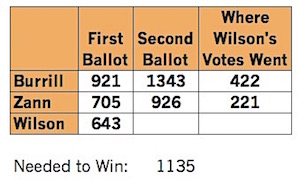
The Dexter Government did have some bad luck, but voters judge governments by how they respond to events. So it was important for the party to repudiate the Dexter crew, and they did so in almost exactly the same proportion as Nova Scotia voters did in 2013 (72-28 Saturday; 74-26 in 2013).
Nevertheless, the second ballot shows Wilson supporters strongly preferred Burrill as the best alternative if their candidate did not prevail. That should help ease the pain of what might otherwise be a humiliating rejection.
Gary Burrill’s mild manner reflects a style that has worked well for Nova Scotia political leaders like John Hamm and Robert Stanfield. As he demonstrated during the campaign, he is a gifted orator. If he invokes too many leftist nostrums, he will alienate the province, just as McNeil and Baillie risk alienating people with their surprisingly rigid approaches.