
02 Apr Whatever happens, Bernie Sanders’ campaign has been remarkable
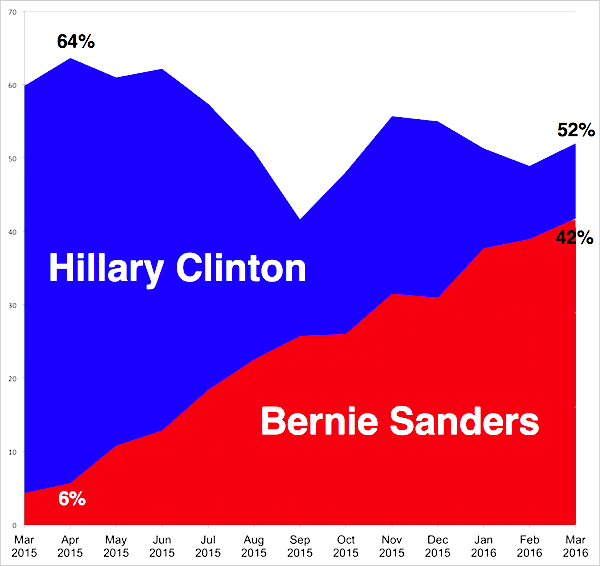
I expect Hillary Clinton to win the Democratic nomination. With somewhat less confidence, I expect her to win a decisive victory over Donald Trump or Ted Cruz in November. Recently, a friend who heard me express this view urged me to look at where Bernie Sanders stood in the polls stood one year ago.
The chart above shows the startling results. It uses a monthly average of the national Democratic polling numbers aggregated at RealClearPolitics.com.* One year ago, Sanders stood at six percent of Democratic voters to Clinton’s 64 percent—a staggering 58-point gap. He’s now at 42 percent to Clinton’s 52 percent—a ten-point gap that continues to narrow.
The Liberal establishment media has grown increasingly dismissive of Sanders’ chances. Clinton is too far ahead to be stopped. Sanders only wins caucus states. Sanders can’t win states with large African-American cohorts.
Liberal economist Paul Krugman wagged his finger at Sanders in a New York Times column Friday, demanding he accept reality and “start acting responsibly” by dialing back criticism of Clinton’s eye-popping wealth accumulation, her hawkish foreign policy, her coziness with big banks.
Well, maybe. The delegate arithmetic strongly favours Clinton. Sanders would have to win about 57 percent of votes between now and the convention to beat Clinton in pledged delegates, while the latest polls still show her with an eight or nine point edge nationally. Even then, he would have to make inroads among the super-delegates, who overwhelmingly favour Clinton.
But as my friend pointed out, it’s astonishing how far Sanders has come in the last 12 months. Clinton’s 58-point lead has shrunk to ten points, with no sign of stabilizing. That a Jewish socialist from Vermont could give her this much trouble shows she is not a strong candidate.
Clinton will still probably win. But the chart illustrates just how badly everyone has underestimated Bernie Sanders.
—
* RCP tracking goes back as far as June 2014, but the results for 2014 and early 2015 were mostly flat.