
18 Jul Further evidence of Canada’s subpar marine protection
Yesterday I published two maps showing impressive efforts by nations large and small to establish massive marine protected areas (MPAs) in the Pacific and Indian Oceans. A third map revealed Canada’s contrastingly anemic effort. Because this is not my field, I added this caution:
This is a complicated topic. It’s possible the comparisons above, in terms of the level and type of protection, do not present a fair picture. I don’t have the knowledge or background to evaluate that. But plenty of people in Halifax do, and I’d love to hear from them.
Hear from them I did. Chris Miller of Halifax, National Conservation Biologist with the Canadian Parks and Wilderness Society, passed along this chart showing the protection effort of the 10 nations with the largest ocean estates. Canada placed dead last:
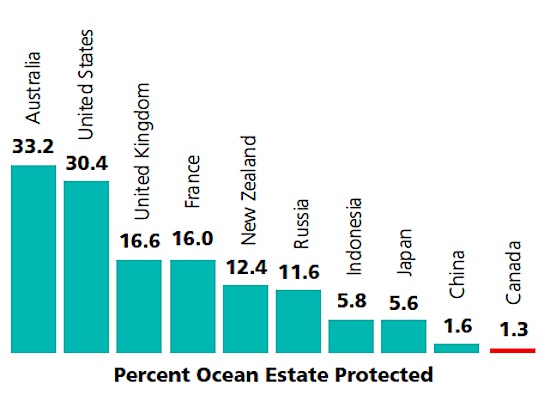
These numbers predate President Obama’s recent pledge to significantly increase the already substantial MPA around Hawaii. Here is the outlook in map format, rounded to the nearest percent:
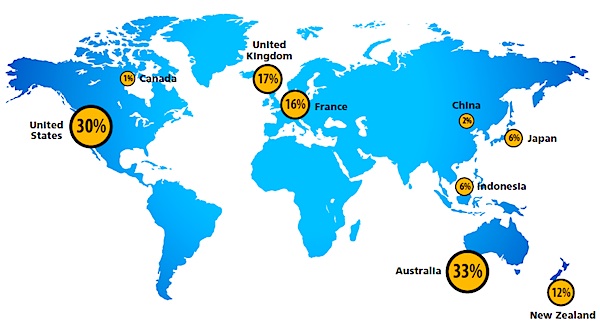
Both charts appear in a detailed assessment CPAWS published last month [PDF], beautifully illustrated and definitely worth a look.
Miller added this useful comment:
As with any assessment of this nature, there are intrinsic challenges with comparing very different jurisdictions… such as Canada, which has very few MPAs, but those we do are well enforced…versus countries that may have substantial MPAs, but ineffective enforcement (paper parks).
The trend toward really big MPAs being established is quite exciting…and definitely the direction the world needs to be moving. Canada is lagging behind by doing one site at a time, and not clearing the path toward more effective and speedy implementation.
Susanna Fuller, longtime ocean activist with the Ecology Action Centre (and longtime friend of Contrarian) offers this snapshot of ocean protection in Canada:
- Less than two percent protected in official marine protected areas
- Commitment to the target of 10 percent by 2020 set by the UN Convention on Biological Diversity, but we don’t expect Canada to meet it
- It takes about eight years to get a new MPA
- Some new funding in the National Conservation Plan, which may get us a few new area closures
- Lots of opposition from fishing industry, and I don’t think an overall respect for the fact that, just as we need terrestrial wilderness areas, we also need marine ones.
- Needless to say, this government is not very proactive on marine protection, and has focused on economic exploitation
- Australia has set up a plan for a huge marine reserve system; US has made good efforts as well, although the conservation community questions (rightly so) the efficacy of the marine sanctuary and national monument programs.
- Always problems with enforcement, but those are getting easier with technology.
- In Canada, we have a piecemeal system of closures from various activities (fishing mostly, and some shipping) but for the most part no comprehensive system or planning.
- Efforts to do this are undermined by industry and in some cases provinces who are most interested in off shore energy.
An anonymous reader objected to my citing the United Kingdom’s establishment of an MPA around the Chagos Archipelago as an example of enlightened marine area stewardship. He linked to an opinion piece by Guardian writer Fred Pearce decrying the reserve as a case of environmental colonialism:
How do you greenwash a large airforce base? A base that is responsible for bombing nearby countries, and which was built on an island you confiscated from residents who are now living in exile on the other side of the world?
Easy. You announce the creation of a giant nature reserve which will be off-limits to its former inhabitants. Not to the military, of course. That might create complications. But the people-free zone will cover the islands and oceans all around. Then, if you’re really clever, you get the world’s premier network of conservation scientists to endorse your plan.
An activist involved in the Chagos protection responded, also anonymously:
Well, this is a very old story, and totally one-sided. It comes from the notion that you can’t have a marine reserve until you resolve all outstanding issues. [Opponents] did everything to undermine the process, despite the fact that a fair number of Chagossians supported the idea. Our line was whoever currently has it must properly protect it, and in the meantime, if governments resolve these issues then that is their concern.
Regardless of the colonial politics muddying that situation, it is beyond reasonable argument that Canada’s ocean stewardship has been dreadful. We fished out the Northern Cod, a resource of biblical proportions, while government cheered on the industrial fishery, an event that ranks with the extinction of the bison and the passenger pigeon in the annals of environmental crime. Yet it seems we are still putting the shortsighted interests of the fishing industry head of the national interest in protecting our ocean treasures.