
12 Oct Remembering BONG Bull
Saturday’s edition of Tim Bousquet’s Halifax Examiner features a list of sites that aggregate the often witty repartee that permeates many newsrooms:
Reporters think about themselves too much, which leads to sometimes funny, sometimes sad, stuff. In no random order [sic], there’s Shit Reporters Say, Overheard in the Newsroom, and the moribund Bureau Chiefs, who were behind the sadly no-longer-funny (what happened?) Fake AP Stylebook.
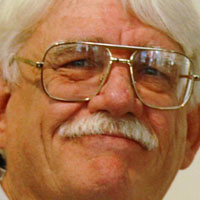
Charlie Stough
This brought to mind the defunct-but-not-forgotten Burned-Out Newspapercreatures Guild Bulletin, “BONG Bull” for short, a creation of longtime Dayton Daily News copy editor Charlie Stough, who produced it from the early 1990s until 2007.
Although BONG Bull began life as an early internet listserv, arriving by email before most editors knew what email was, it conjured the rapidly fading newspaper world of glue pots, foot-long scissors, and green eyeshades. It featured a potpourri of copy-desk yarns, miscues, and jabs at press barons, delivered in droll, curmudgeonly prose.
A sample:
WORLD’S BEST RESIGNATION LETTER. CLIP AND SAVE.
Dear Managing Editor:
I hereby resign as a reporter. I have decided I would like to accept the responsibilities of an ordinary human again.
When management demands we pull an all-nighter and offers to cater dinner, I don’t want to look at cold pizza and warm coffee.
I don’t want to have to stop work and dance in a circle around whoever buys a new raincoat or gets a mole removed just to get the damn cake.
It hurts to admit I can’t be managing editor because I’ve been here too long.
Telemarketers get more respect.
Nobody flipping burgers brags that they went to the University of Missouri. Well OK they do, but it was the Business School.
I want to think that the world is fair; that everyone is honest and good and anything is possible.
There must be a profession somewhere that Ted Turner isn’t a role model for.
If life is a walk on the beach at sunset, this job is sand in my pants.
I want a job where if the computers crash, the truckers go on strike or the presses burst into flame, the guy who bought the computers, hired the truckers and chose the presses doesn’t yell it’s my fault.
Would two weeks’ notice be enough?
Another:
BROTHERHOOD OF THE PEN.
A city editor and his wife were wakened at 3 a.m. by a loud pounding on their front door. The editor stumbled down and opened to find a reporter on the porch in a driving rain, staggering drunk.
“Can you give me a push, Boss?” the reporter slurred.
“Not a chance. And if you bother me again at this time of the night, it’s your ass!” the editor said, slamming the door.
But his wife was more sympathetic. “Don’t you remember when you were a young reporter?” she asked. “Out late in terrible weather, digging up stories? I think you should help him, and you should be ashamed of yourself!”
The editor grumbled but did as he was told, got dressed, and went out into the rain and dark. “Hello, are you still there?” he called out.
“Yes,” came the reply.
“Do you still need a push?”
“Yes, please!” said the reporter in the dark.
“Where are you?” asked the editor, squinting into the gloom.
“Over here, on the swing!” replied the reporter.
One more:
BOOK REVIEW COLUMN.
So you’re cutting the book review section, huh, Boss? Bookstores don’t advertise? Educators wielding Silas Marner have bludgeoned your young readers into fear and loathing of good writing? If it’s not Harry Potter, who cares about new titles?
So deal. Why not report old titles instead? Amazon.com will never think of it, because the books are free, down in the storage dungeons of public libraries.
Consider:
— “A couple of wise guys seduce and abuse a country teenager in the big city, but she soars to stardom while her captors go to ruin.” That’s “Sister Carrie,” by Theodore Dreiser, banned in Boston in 1900. The critics wanted victims to pay a steeper price. Meanwhile someone was writing the lesson plan for “Silas Marner,” a groaning yawner about a cataleptic weaver. Guess which one’s on the final.
— Speaking of Boston, how about H.L. Mencken’s nonfiction chronicle of a long legal fight with censors in 1926, “The Editor, the Bluenose and the Prostitute.” It’s a lesson in what today’s talk-radio yahoos try to do to reportage they don’t like, and what gutsy publishers can do in response.
— Speaking of yahoos, there’s Larry McMurtry’s “Walter Benjamin at the Dairy Queen,” a memoir that exposes Texas’ phony history of hip-shooting loners righting all the wrongs of the world. It goes a long way to explaining how we got neck-deep in an impossible war.
— How about, “A drug addict invents a marvelous city in caves of ice, but he’s so loopy that when someone bangs on his door, he forgets it all.” Welcome to “Kublai Khan,” a poem by Sam Coleridge and a lesson
in sobriety if not call screening. For all the ignorance about poetry that students bring to the world today, there has never been a time when poets made as much money as now, writing song lyrics. This is a market a smart columnist could steal from MTV.
Tom Mangan’s Banned for Life blog, a collection of reviled news media cliches, was inspired by Stough and BONG Bull.
BONG Bull was distributed free, but partly supported by the sale of such swag as typewriter-key tie tacks, personalized Chagrin Falls Commercial Scimitar Foreign Correspondent press cards, and the BONG Pejorative Poster, which listed 120 newspapers by their disdainful street names (The “Boregonian,” the “Mop and Pail”).
Copies of BONG Bull are fragmentarily archived here and here. Someone really should resurrect a complete archive.