
10 Jan Trauma days—might teachers actually need them?
Last week, I cheered on a sardonic Contrarian reader who mocked the suggestion that some teachers with children of refugees in their classrooms are suffering from “vicarious trauma,” for which they may need counselling. Sort of like second-hand smoke, I guess.
Dan Bedell, Atlantic Region Communications Director for the Canadian Red Cross, thinks the sardonic reader and I are making light of a well-established mental health problem.
I read the recent Trauma Days post just after reading this story about Red Cross personnel helping Syrian refugees cope with the stress and trauma they’ve endured, both in Syria and since seeking refuge elsewhere.
To me, your sardonic observer is poking fun at a mental health issue that is not some fad arising from the plethora of recent terrorism headlines but in fact has been documented as far back as the 1950s among some workers who deal with victims of trauma, regardless of the source.
In this case it involved children who may have witnessed atrocities. Vicarious traumatization (VT) is also referred to as compassion fatigue and has been observed in doctors, nurses, first responders, psychologists, social workers, humanitarian workers, clergy, teachers and even journalists, among others.
VT may not garner the level of media coverage and public debate seen in recent years for Post-Traumatic Stress Disorder (PTSD) but anyone experiencing one or the other, or perhaps both, deserves understanding and support, not ridicule. In my view, it’s good to see that educators are at least aware of its potential so appropriate support can be sought should the need arise.
I should point out that Dan Bedell is a longtime friend. I knew him first as a wire service reporter, later as a communications officer for the Canadian Forces, and for Environment Canada, where he was a rare voice of common sense on the Sydney Tar Ponds cleanup. He is neither naive nor sentimental. Nevertheless, the likelihood that teachers might need trauma counselling in these circumstances leaves me unmoved. I responded:
First, hard evidence for the effectiveness of trauma counselling given to victims of actual trauma, let alone the vicarious kind, is hard to find. The few well designed studies don’t show much difference between those who got counselling and those who didn’t.
Second, the concept of vicarious trauma, at least as applied to Nova Scotia teachers of refugee children, strikes me as a form of faux empathy, akin to those with no connection to a highly publicized tragedy who nevertheless rush to the scene of the incident so they can place flowers and teddy bears and sob for the cameras. For some reason, our era has spawned people so titillated by tragedy they take pleasure in suffering from it, even when it has no actual connection to their lives.
Bedell said the concept of vicarious trauma, also known as compassion fatigue, dates from the 1950s. Coincidentally, Malcolm Gladwell’s 2004 New Yorker essay, “Getting Over It,” takes as its starting point a gruesome scene from the start of the best-selling 1956 novel, The Man in the Gray Flannel Suit. The protagonist suffers a hideous trauma, but after some thought, decides he has no choice but to get on with his life.
The point of the essay is that our attitudes about the effects of trauma have undergone a 180 degree flip since the 1950s. Gladwell (and I) believe humans are more prone to resiliency than victimization, and the academic literature lends at least some support to this view.
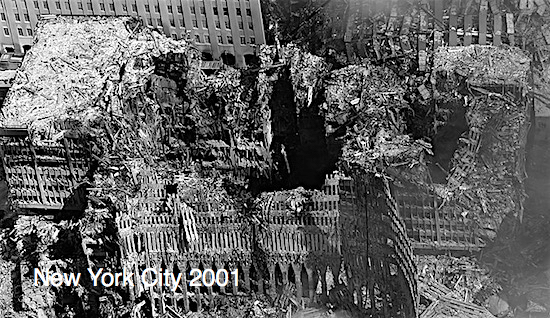
Also in 2004, another New Yorker writer, Jerome Groopman, looked at evidence of traumatic impact from the 9/11 World Trade Centre attacks.
Despite the influx of counsellors into Manhattan, most New Yorkers received no therapy following the attacks. Furthermore, data from surveys taken after September 11th contradicted the early predictions that there would be widespread psychological damage. A telephone survey of nine hundred and eighty-eight adults living below 110th Street, conducted in October and November of 2001, found that only 7.5 per cent had been diagnosed as having P.T.S.D. (According to the American Psychiatric Association, a patient is said to have P.T.S.D. if, for a month or more after a tragic event, he experiences several of the classic symptoms: flashbacks, intrusive thoughts, and nightmares; avoidance of activities and places that are reminiscent of the trauma; emotional numbness; chronic insomnia.) A follow-up of this survey, in March of 2002, found that only 1.7 per cent of New Yorkers suffered from prolonged P.T.S.D. This finding indicates that the debriefing industry is predicated on a false notion: that we are all at high risk for P.T.S.D. after exposure to a traumatic event.
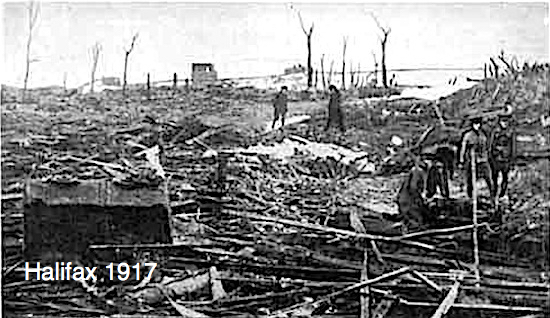
This was dealing with primary traumatization, not the secondary or vicarious variety. Again coincidentally, there is a Halifax angle to this work, as Groupman recounts:
In 1917, a traumatic event on a scale similar to that of the September 11th attacks took place in Halifax, Nova Scotia. Two ships collided near the dock, one of which was carrying explosives and benzene, a flammable liquid. The crew abandoned this ship, and it drifted to the dock, where it exploded and destroyed the entire north end of the city—an area encompassing two and a half square miles. More than two thousand inhabitants were killed, and nine thousand were injured—many of them blinded and dismembered. The night after the explosion, a blizzard descended on Halifax, hindering the relief effort, and many people whose homes had been destroyed froze to death.
April Naturale is a psychiatric social worker who heads Project Liberty, a government-sponsored program that was established to coördinate the therapeutic response to September 11th. Not long ago, she went to Halifax to read archival materials on the 1917 accident. “Some of those who survived seemed psychotic, hallucinating for days,” she told me. One woman continued to speak solicitously to someone named Alma—her dead child; other victims were in such a state of shock that doctors were able to perform surgery on them without using chloroform. But after a week or so these disturbing symptoms spontaneously subsided in the vast majority of cases. These accounts led Naturale to conclude that psychiatric intervention in the wake of such an event should be minimal; the mind should be given time to heal itself. In short, the “abnormal” behavior witnessed in the aftermath of the explosion was actually part of a healthy process of recovery.
Last word to Bedell, quoting his response to my response:
I have talked to people who have left our organization or others due to feelings of helplessness or inadequacy of their efforts to help traumatized victims of disasters like the earthquake in Haiti and Ebola outbreak in Africa. To me, that’s compassion fatigue. However the majority with comparable experiences including all the setbacks and failings found it inspiring and motivation to do even more. So resilience is alive and well. I haven’t read widely on this, but our own materials from our Employee Assistance Program provider acknowledge compassion fatigue, though caution that symptoms, diagnoses, treatment (if even necessary) and outcomes vary widely. Much like PTSD where there are no two cases the same and some argue the criteria is so broad that almost anyone could get a diagnosis.