
28 Feb Zero and counting
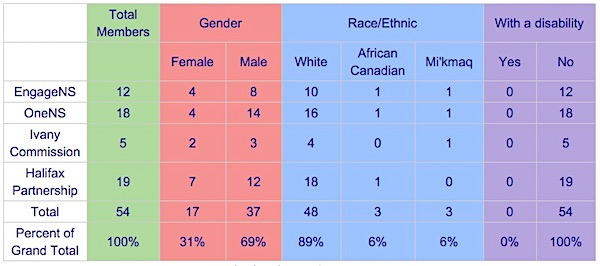
Justin Trudeau usefully observed that gender parity in public affairs should be a foregone conclusion by now, not an opportunity for backslapping congratulations. Likewise, when Nova Scotia establishes councils and commissions to consider broad policy issues, the province usually takes care to include Mi’kmaq representatives and (somewhat less diligently) African-Nova Scotians.
But what about people with Disabilities?
At his James McGregor Stewart Society blog, disability rights advocate Gus Reed has tallied up the gender, race, ethnicity, and disability status of the 48 directors of the Ivany Commission, Engage Nova Scotia, the OneNS Coalition,* and the Greater Halifax Partnership, organizations attempting to re-envision Nova Scotia’s economy.
The results are dismal. Writes Reed:
The accepted figure for Nova Scotians with disabilities is 18%. Like the other subgroups, participation in the labour force varies with age. Overall, people with disabilities of working age have a somewhat lower employment rate (49%) than others (73%). No matter how you slice it, people with disabilities are underrepresented on the commissions.
Reed points out that the Halifax Partnership is hosting a job fair at the waterfront Marriott Tuesday, including a Hiring Resource Workshop focused (he speculates) on explaining “how businesses can take advantage of government and quasi-government programs that encourage employment.” Reed notes that none of the organizations listed as resources for the job fair has much if any expertise in programs that help employers hire people with disabilities.
Taxpayers have a real stake in this. Every time a person with a disability is hired, there are potential savings from community supports. The Department of Community Services provides up to $10,000 annually to support people with disabilities who should really be in the labor force. This could save Nova Scotia taxpayers over $100 million a year. DCS also is the provincial signatory to the Canada-Nova Scotia Labour Market Agreement for Persons with Disabilities, which is the main source of incentives for training and employing people with disabilities.
Failing to include these programs is the sort of oversight that happens when minority groups are excluded from governing bodies of organizations that guide public policy. In the case of people with disabilities, the exclusion is routine and nearly universal.
—
* Disclosure: I briefly served on a subcommittee of the OneNS Coalition, and never thought to consider the organization’s failure to include people with disabilities.