[caption id="attachment_1270" align="alignright" width="325" caption="The Boss"]dexter-finger-adjusted[/caption]
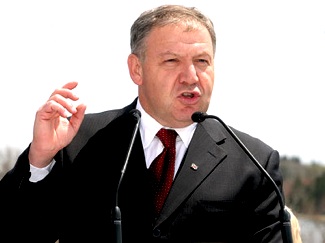
Premier Dexter's office is quietly taking a firm hand in the hiring of ministerial executive assistants, insisting the new hires must be chosen for their policy chops. Officials in the premier's office will begin interviewing candidates for long-term EA positions next week, replacing the makeshift crew of temporary EAs assigned immediately after the election. The move suggests the Dexter Government could feature a Harperesque degree of central control. Executive assistants are explicitly political positions tied to a ruling party's tenure. Each minister gets an EA to help with political aspects of the job, including major constituency issues and partisan concerns related to a minister's portfolios. They are not to be confused with the eight unpaid 'ministerial assistant' positions Dexter handed out Monday as sops to disappointed backbench MLAs who lost out in the 12-person cabinet sweepstakes.

Eleven Canadians living in the United States celebrate Canada Day by telling the New York Times what they miss about Canada. Moneyquote: We call our dollars loonies because the coin has an image of a loon in flight. Another old bird, the Queen of England, is on the other side of the coin. I remember singing “God Save the Queen” every morning in school. “Long live our noble Queen!” we belted, thousands of us tubby little obedient Canadians. I guess it worked. She’s still alive. (Rick Moranis) Unlike many of her generation, the late Cape Breton Post writer Eleanor Huntington, who died...

Not owning a TV, at least one connected to the outside world, contrarian is a little late with this, but it's worth reading. CTV Atlantic's Steve Murphy deftly navigates the border between politeness and persistence, while the Prime Minister Stephen H. squirms.
Q: You have been spending a good deal of time with Ignatieff lately working on this compromise that averted the election, and at same time your party is running ads that attacked Mr. Ignatieff. And frankly, we and other broadcasters have been getting complaints about those ads. How do those ads right now improve or dignifiy the political process?
Some days ago, contrarian reader Wallace J. McLean challenged contrarian to determine how many of the paving projects Nova Scotia submitted for federal stimulus funding were in provincial Tory ridings. "Too much work," we said, and went back to surfing Digg and Stumbledupon. Well, turns out Wally is a blogger himself, and after days with a magnifying glass comparing project lists with the boundaries of Nova Scotia's 52 provincial ridings, he offers an answer:
Of the 37 projects put forward by the late Macdonald government in NS, five were located in Liberal districts, and five in NDP districts, based on the 2006 election results.... Twenty-six were located in districts which the Tories held, or had won in 2006.

Defeated Green Party candidate and perennial political gadfly Michael Marshall, who has been hounding his party's executive to comply with financial disclosure rules, finds the legislation governing riding associations too complicated—and a damper on participation. Elections Canada is asking the parties if the added complexity of their new election legislation is reducing the number of people willing to get involved in the political process. Part of the reason for the lower voter turnout is because, in many ridings, only one or two parties are truly competitive—and the complexity of election laws is one reason that many riding executives are so weak—no...

The anonymous senior official inside Transport Canada who responded to contrarian's revelation that the Harper Government steered Infrastructure Stimulus Plan paving projects to federal Tory ridings in Nova Scotia, responds to reader feedback: What your readers may not know is that senior bureaucrats are moved at the behest of the Clerk of the Privy Council and approved by the Prime Minister — a subtle but important distinction.  They (we) are not Liberal appointees any more than the current crop are Conservative appointees. When the Liberals were in power, they were convinced that some deputies were closeted Conservatives (as many were/are).  It doesn't...

Several readers argue there's nothing wrong with the Harper Tories steering infrastructure money to their own ridings, or pushing out deputy ministers who object, because (1) the money will be spent anyway, (2) the Liberals did it too, and (3) most senior civil servants are Liberal appointees. After the jump, a spirited response from longtime gadfly and former Dartmouth City Councillor Colin May, but first, contrarian reader Wayne Fiander weighs in: 
Since you went to great trouble to note [ousted Deputy Transport Minister Louis] Ranger's expertise, you should have also informed your readers that Mr. Ranger "in the mid 90's, took a two year assignment with the Privy Council Office. He then returned to Transport Canada as Assistant Deputy Minister, Policy and was appointed Associate Deputy Minister of Transport in 2001"  and was appointed DM at Transport Canada in 2002.  His connection to the Chretien Liberals is quite deep and therefore sheds the full light on his obviously political comments.
Good point. I should have noted that. But the implication that a two-year stint in the PCO 15 years ago justifies Ranger's firing is bogus. The Harper crowd used public money for partisan purposes. That's corrupt. Full stop. Getting rid of qualified civil servants who raise objections to this corruption is of a piece with that.

[caption id="attachment_1005" align="alignright" width="154" caption="Departing DM Louis Ranger"][/caption] Our post on the skewing of paving projects under the federal Infrastructure Stimulus Plan elicited the following e-mail from someone who claims to be (and sounds very much like) a senior official inside Transport Canada: I wondered how long it would take for the media to discover that the infrastructure stimulus spending has everything to with patronage, and nothing to do with what is good for the nation. [Deputy Minister Louis] Ranger [whose retirement was announced yesterday] was pushed out of the job and told, "We don't want your advice" regarding the spending projects. ...

Contrarian reader Wallace J. McLean wonders: How does the map of road work requested by Premier Fiddler compare to the provincial electoral map as it stood prior to dissolution? It's an obvious question, but from a look at the map, I doubt the answer would turn up anything nefarious. Provincial paving, by its nature, takes place mainly in rural ridings. That's where provincial roads are. Before June 9, Tories held most of the province's rural constituencies, so most of the proposed projects were undoubtedly in Tory ridings. To show bias, one would have to demonstrate that province's proposed infrastructure projects disproportionately favored Tory...

When the Harper Government announced an Infrastructure Stimulus Plan focused on construction-ready projects, Nova Scotia saw a golden opportunity to make headway on a huge problem: its crumbling highway system. The province sought federal approval for 39 paving projects. But Ottawa approved only 20 of the paving jobs. Since the 19 rejected projects were all but identical to the 20 that received a federal go-ahead, it's hard to figure out what criteria Ottawa used for its decisions. Until you look at a federal electoral map. Projects in ridings held by Conservative MPs were almost four times as likely to receive federal approval...