I described a 250-gigabyte laptop hard drive  as "impossibly huge." Ivan Smith found one twice as big at Tiger Direct: a 500 gigabyte Hitachi Travelstar laptop drive for just $99. That's 1¢ for every 50 megabytes. Ivan has more on the incredible shrinking price of data storage here....

Google CEO Eric Schmidt speaking at the Techonomy conference Wednesday: There was 5 exabytes of information created between the dawn of civilization through 2003, but that much information is now created every 2 days, and the pace is increasing...

How a video goes viral: Sometime on Wednesday, Halifax filmmaker Andrea Dorfman uploaded her lovely video, featuring Tanya Davis's poem about solitude, to YouTube. At 6:38 a.m., Friday, when Halifax artist Shelagh Duffett reposted the video to her website, it had been viewed 40 times. Kimberley Mosher, an account manager for a Halifax Advertising agency, saw it on Shelagh's site and put it on her Facebook page, where, in turn, fashion blogger Allison Garber saw it and reposted the link to her FB page. All this happened in less than three hours. Allison's and my mutual friend (and brilliant, Baddeck-based communications strategist) Stacey Pineau sent me the link...

The blogosphere is agog at a Washington Post series that uncovers the astonishing, bloated, secret, and likely ineffective national security apparatus that has grown up in the United States following 9/11. Two crack WaPo reporters, Dana Priest and William M. Arkin, spent two years tracking down the story, an increasingly rare example of what the dead-tree media can do when it taps its traditional strengths. Here's the opening sentence: The top-secret world the government created in response to the terrorist attacks of Sept. 11, 2001, has become so large, so unwieldy and so secretive that no one knows how much money it...

Soldiers herd sheep off the apron of the air force base at El Alto, Bolivia, so the BAe 146 military transport jet in the background can take off....

Alexis Madrigal, Atlantic's new tech blogger, poses the question this way: You hop onto a parent's computer to check your email or do a little work. But, to your dismay, the only browser available is Internet Explorer and (for whatever reason) you don't like Internet Explorer. You download Firefox (or Chrome), then install and launch it. Firefox (or Chrome) then asks whether you want to make it your (Mom's) default browser. Of course you do! But should you really make this decision for Mom? Yes, says Madrigal, quoting a mashup of Tweeted responses: "It's our responsibility to help our parents figure out technology"...

Cape Bretoners are accustomed to coincidental connections because their homeland offers such fertile ground for them. The combination of summer residents, occasional visitors, and the vast Caper diaspora has seeded the planet with people eager to rekindle their connection to the island. The late Whitney Pier ship chandler Newman Dubinsky made a point of wearing a Cape Breton tartan ball cap on his frequent travels overseas, because of the conversations it was sure to spark. For different reasons, blogging can have the same effect. My ex-sister-in-law, Myra Barss, is in New York, clearing out her parents' house. She emailed a dealer...

Best Buy has apparently relented on its threat to fire smartphone salesman Brian Maupin, 25, for his parody of an Apple fangirl rebuffing a salesman's efforts to sell her an HTC Evo instead of the out-of-stock iPhone G4. Warning: major profanity alert. Neither the original animated film, nor Maupin's rebuttal parody, in which an Evo-owner tries to get his phone fixed at an Apple store, so much as mentions Best Buy — but they do have nearly four million views between them, which may have persuaded the giant retail chain to reconsider the PR wisdom of humour-challenged personnel management. Hat tip: Leo Laporte....

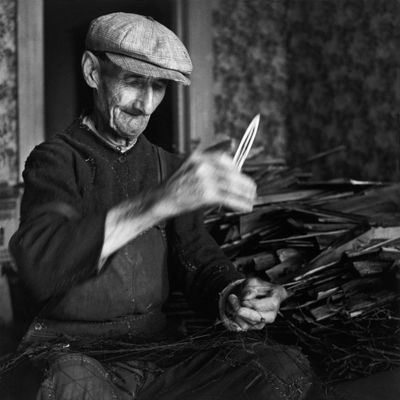
Peter Barss, at yesterday's opening of his rescued Images of Lunenburg County at the Anderson Gallery:
As you look at these pictures and read the text panels from the book I imagine you’ll be asking yourselves the same question that has perplexed me for years: how did these men survive... without Wal-Mart? Images-Barss-040Right after Myra and I were married we spent a few nights in the West Ironbound lighthouse with our friends Ingram and Lynn Wolf, the light keepers on the island. One evening Ingram set out to rake up some grass but couldn’t find his rake. So he made one. Drilled some holes in a narrow board, whittled wooden pegs for the teeth, and walked into the woods to cut a sapling for a handle. Ingram had the grass raked up before the sun set. That memory has remained with me as emblematic of the self-sufficiency and resourcefulness of the people represented in this exhibit, If I had needed a rake it would never have occurred to me that I could make one. I would have headed directly to the hardware store. These men could fix anything that went wrong with the engines in their boats with nothing more than a screw driver and a pair of pliers, they navigated through fog as thick as pea soup, and they could tell you what the weather would be in coming days more accurately than the forecasters of today who seem to believe that staring at computer screens will give them more information than stepping outside and learning what nature has to tell them. These men lived at a time when communities were relatively isolated, families were closer and people had more time for each other. Neighbors depended on neighbors in good times and bad times. There were community dances and parties and when men were lost at sea --which happened all too frequently--the entire village grieved with the family. They were not rich men and they didn’t own a lot of stuff. But they were only poor in an economic sense. One man told me “I remember back... there was nice feelings in them times. We had nothin’... but you was a millionaire.” It’s easy to romanticize the era this exhibit portrays. No one wants to go back to those days... but maybe we should look back and think about what we have lost.
The show is up until August 4. After the jump, Peter describes the work a Halifax design shop put in restoring the images, the negatives for which had been lost in a house fire a quarter century ago:

I'm new to blogging and still feeling my way around the courtesies and protocols of the genre. When I post an item I found somewhere else, I usually credit and link to the source where I encountered it — a figurative tip of the hat. Sometimes I dig deeper and link to the original source material, and sometimes to both ("hat tip [originator] via [mysource]"). These links are courteous to my comrades in the ether, and provide a richer experience for the reader. Traditional news organizations sometimes complain that the whole blog world is an endless exercise in ripping off their...