I was struck by the portentously antiquarian wording of the New York Times' lead headline the morning after the calamity in Port-au-Prince: Haiti Lies in Ruins; Grim Search for Untold Dead I may eventually have something to say about this ghastly, stultifying event, but for the moment, I am speechless. ...

Last Tuesday, BBC Radio 4's Making History series broadcast Sable Island – A Dune Adrift, reporter Sean Street's documentary about "Nova Scotia's Galapagos." At the Natural History Museum, in Halifax, [Sean] witnesses the unpacking of the latest consignment of bones and specimens – extraordinary ancient walrus skulls – collected by Zoe Lucas, who has been on the island for decades. He meets artist Roger Savage who had to tie his easel down, clamp his paper and battle with the scouring sand as he captured the landscape of the place in his paintings. And he meets a man who dedicated years to...

Walking trail, Live Oaks Reserve, Gulf Islands National Seashore, Gulf Breeze, Florida...

The UK Telegraph has a witty tee-up for the Copenhagen conference, where celebrity travel and other extravagances will produce the equivalent of 41,000 tonnes of CO2, an amount equal to that produced by a small British city over the same period. Among the nuggets: [T]his being Scandinavia, even the prostitutes are doing their bit for the planet. Outraged by a council postcard urging delegates to "be sustainable, don't buy sex," the local sex workers' union – they have unions here – has announced that all its 1,400 members will give free intercourse to anyone with a climate conference delegate's pass. The term...

Contrarian reader Dana Doiron offers a subtly different take on Elizabeth May's performance in the recent Munk debate on climate change: I suspect that May was uncomfortable with the black and white (not another crayon issue) framing of the proposition.  One can support individual and collective action in response to climate change without making it the end-all and be-all, just as one can support our soldiers while having reservations about the conflict to which they have been deployed....

Contrarian reader and tech fixer Mike Targett points out that Guardian columnist George Monbiot, whose blistering denunciation of Canada's climate change policies appeared here yesterday, was in Toronto to take part in a Munk Debate Tuesday. One of a series sponsored by Aurea Foundation, the debate considered this proposition: "Be it resolved: climate change is mankind's defining crisis, and demands a commensurate response." Monbiot and Elizabeth May took the affirmative; Bjørn Lomborg and Lord Nigel Lawson the negative. Audience polls taken before and after the debate showed the con side to be slightly more persuasive. My reading is that Lomborg and Lawson...

The rhetoric is over the top, but the facts are only somewhat overstated in a UK Guardian column that foreshadows complaints Canadians can expect hear as the Copenhagen climate change summit approaches: After giving the finger to Kyoto, Canada then set out to prevent the other nations striking a successor agreement. At the end of 2007, it singlehandedly blocked a Commonwealth resolution to support binding targets for industrialised nations. After the climate talks in Poland in December 2008, it won the Fossil of the Year award, presented by environmental groups to the country that had done most to disrupt the talks....

A highly scalable map [5 meg .pdf] of offshore wind farm installations in northwestern Europe shows how far behind Canada is in exploiting this renewable energy source. The map detail at right is a static screen capture, at far less than maximum enlargement. (The map is reminiscent of various offshore petroleum maps of Nova Scotia's, an example of which can be downloaded here [400-k .pdf].Hat tip: Colin May....

"Oil," a major exhibition by Canadian photographer Edward Burtynsky, is currently on display at the Corcoran Gallery of Art. in Washington, DC. The exhibit includes horrific photos of the Alberta Tar Sands: Burtynsky-06-s [Click images for larger view - links fixed.] Burtynsky specializes in sweeping, often eerily beautiful views of landscapes altered by industry: mine tailings, quarries, scrap piles. James Fallows, of the Atlantic, which features another of Burtynsky's images this month, writes:
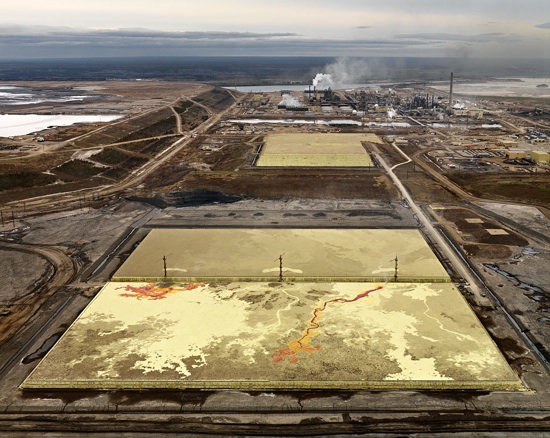
The impact of the exhibit as a whole is, well, hard to convey in words.... [V]ery few people have seen the range of oil-industry artifacts that he has captured in his wall-sized and incredibly-detailed photos. Extraction and refinery operations around the world; the industries oil has made possible; the indications of the end of the oil era. Hard to forget.
The exhibit moves next to The Rooms Art Gallery in St. John's, Newfoundland, where it will be on display from May 7–August 15, 2010. It will continue to travel through 2012. More photos and a video after the jump.