Category: Money
Dredge it, and they will come. And we will throw them out.
Headline: CBRM to seek control of Laurentian Energy’s greenfield site
Headline: CBRM warns harbour site suitor
Let me see if I have this straight:
The Cape Breton Regional Municipality, which is $102.9 million in debt, and which constantly complains that it can’t afford to provide basic services, is going to borrow $6 million to buy 400 acres of harbour-front land, or a lesser amount to buy a controlling interest in the company that is selling the land, all to block — yes, block! — a proposed industrial development, so it can “save” the land for a fantasy container pier that will never, ever happen.
CBRM can afford to do this because it is overflowing in industrial development, and because a glorious fantasy in the bush is worth a real industry in the hand, especially in an election year.
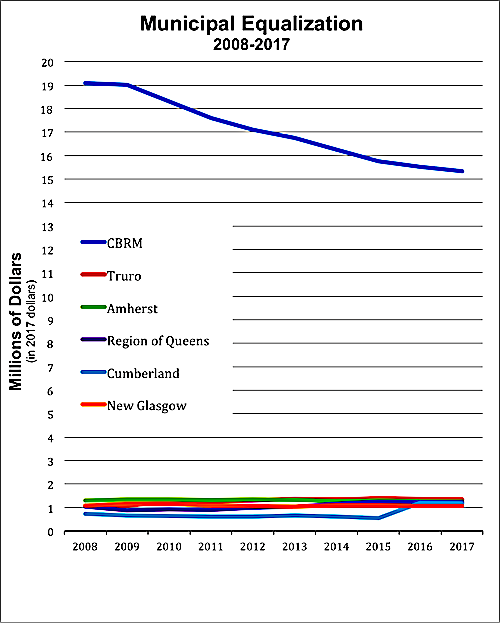
CBRM can borrow beyond its already unsafe debt-service ratios, because it will be rolling in cash as soon as it gets the evil oppressors in Halifax to start forking over its rightful level of handouts, or rather, equalization payments. (The current level is more than what Halifax sends to all other municipalities in the province, combined.)
Dredge it, and they will come. And we will put the run on them. This is what passes for economic development strategy in the fervid brains of CBRM’s mayor and council.
There may be legitimate reasons to question this proposed development. But pretending Sydney is going to get a container pier isn’t one of them. That fraud has gone on long enough.
Anderson Gunning — feedback
Dan Bedell, Atlantic Canada Communications Director for the Canadian Red Cross, adds a useful postscript to my piece about the unusual pairing of bluesman Matt Anderson and folkie Dave Ginning at a Halifax Chamber of Commerce dinner on May 2.
Matt’s a big guy with a big heart. He’s from the Perth-Andover, NB, area, where he organized a benefit concert April 28 that included Bruce Guthro and Lennie Gallant among others.
Perth-Andover’s population is only about 1900, and there were close to 1200 in attendance, while others watched via live web streaming. Ticket revenue and various door prize/50-50 sales, plus cash donations at the event or direct to the Red Cross during the concert, totalled just under $48,000, which the New Brunswick government agreed to match. So in a few hours, Anderson’s initiative raised close to $100,000 to assist families and individuals most affected by flood damage to their homes.
It’s not just Matt. Surveys always put artists and musicians at or near the bottom of income surveys, but they’re the ones called upon when a worthy cause needs money. If you added up the funds these folks raise every year, the total would be in the millions — an industry in itself.
In support of $200 fill-ups
Yesterday, I succumbed to self-pity about a gastank fill-up that edged perilously close to a C-note. Contrarian regular Denis Falvey offers a dose of reality:
We will never get off our dependance on gasoline until the cost of a gallon of the stuff is through the roof. That’s what makes the alternatives affordable.
I am told that Quebec is currently building the infrastructure necessary for electric cars, and has an $8,000 allowance for each person buying a Volt. Whether that is good or bad, do you think it would happen with gas at $0.50 a gallon?
As long as fish caught off our coast can be shipped to China for processing and then sold on our market two things are true – gas is too cheap, and so is Chinese labour.
Smile! This is change happening. Local may become important again.
No calls in 14 years

The management of Simeon’s Family Restaurant in Sydney attached a makeshift sign to the venerable but non-functioning Bell-Aliant pay phone in the restaurant’s vestibule.
With the explosion in cell phone ownership and use, timely maintenance of the ancient pay-per-use devices just isn’t a priority any more.
“Trying to find a working pay phone,” wrote one friend when I posted this photo on Facebook, “is like trying to find a four-leaf clover.”
“I love pay phones,” wrote another. “They hint at a world of possibilities.”
Edging toward the $100 fill-up

The outcome of a fill-up this morning at Spike and Margie’s Irving at Boularderie Centre, NS. In my 50 years as a driver, the nominal price of gasoline has increased more than 22-fold. In real terms, after adjusting for the consumer price increase, the price has increased 2.94-fold.
Now get rid of the nickel
Contrarian readers know I have no affection for the Harper Government. There are, however, occasional advantages to having hard-assed right-wingers in unfettered control. The willingness to do obviously sensible but unpopular things—like getting rid of the penny—is one of them.
The penny should have been killed decades ago. Taxpayers lose money on every one we mint. Consumers and storekeepers lose 492 million hours every year handling the all but worthless chips. (Yes, I made that number up, but it can’t be far off.)
But… the government should have gone further and ditched the nickel, too.
Donham’s Law of Coinage states that when a government adds a coin on top, it should remove one on the bottom. We added the loonie in 1987, and we should have got rid of the penny then. We added the toonie in 1996, and that would have been a perfect time to get rid of the nickel.
Today’s nickel will buy what a penny would have bought in 1973. Today’s dime will buy what a penny would have bought in 1949. I was only four at the time, but as far as I know, we got along just fine with the metallic currency in circulation then. Get rid of the nickel.
The movies get it. Why can’t reporters?
Sometimes the movies understand issues that reporters and editors seem incapable of grasping. Like the entrenched police habit of grossly inflating the value of illicit drugs they seize, values almost always reported as Received Truth.
In The Guard, John Michael McDonagh’s hilarious comedy about the culture clash between an uptight FBI agent and a small town Irish cop, FBI Agent Wendell Everett, played by Don Cheadle, is briefing members of Ireland’s Garda police force about a drug ship carrying $500 million worth of cocaine, when Sgt. Gerry Boyle, his small town Irish counterpart, played with impecable timing by Brendan Gleeson, interrupts.
Wendell Everett: That’s half a billion.
Gerry Boyle: Street value.
WE: Pardon me?
GB: Street value. You lads are always announcing a seizure of drugs with a street value of $10 million or $20 million or half a billion dollars. I do always wonder what street it is you’re buying your cocaine on, because it’s not the same street as I’m buying my cocaine on.
Watch the clip here.
Jobs and politics, NDP style — “That’s just wrong.”
Nova Scotia’s New Democratic Party is wasting no time making hay in the sunshine of its Bowater bailout with a direct-mail flyer that’s sure to infuriate opposition parties.

The one-page card, featuring a photo of Premier Darrell Dester and Queens MLA Vicki Conrad, will start appearing in South Shore mailboxes this week. It uses Chronicle-Herald headlines to highlight the Dexter Government’s rescue of the financially shaky newsprint mill, contrasting it with a jaundiced appraisal of opposition efforts.
The NDP government is protecting 2,000 jobs with an investment in the mill workers and the Bowater Mersey pulp and paper mill in Queens County by targeting help in training, energy efficiency, and productivity improvements….
During difficult times, the people of the South Shore stood together. And I am proud to say the Government of Nova Scotia stood right there with you. — Premier Darrell Dexter
But those opposition scoundrels?
The Liberals and Tories are still doing old-style politics.
They are opposing the deal to save 2000 jobs.
But they won’t put forward a plan of their own.
That’s just wrong.
Ouch. Could this be the first volley in the 2012 election campaign?
Cape Breton Post editorial takes on Mayor John Morgan
In a rare instance of a local voice taking on Sydney’s popular but incessantly negative mayor, a Cape Breton Post editorial criticized two recent tweets by His Worship: It was typical Morgan stuff:
… there is no evidence that our region can survive under the current governance structure in Nova Scotia
and
It’s not survivable for businesses and it’s not even survivable for families impacted to have that level of taxation burden with less than half the service levels. It is corrosive to the entire community.
In a leader titled “The Eternal Pessimist,” the Post nailed the destructive impact of the mayor’s constant whining:
[T]he picture he’s painting is not only negative, it’s untrue. Many local businesses and families are not only surviving, they’re thriving, despite paying higher taxes and having access to fewer services than residents of the provincial capital.
Morgan calls that putting “a positive spin on what is unfolding.” But it’s not spin, it’s the truth.
Undoubtedly, some businesses and families are struggling. Would it help if more government jobs were located in Cape Breton? Yes. Would it help if the province distributed more equalization money to the municipalities? Arguably, but that would mean less money in the provincial coffers, so something would likely be cut.
What Morgan doesn’t seem to understand — or chooses to ignore — is that a mayor can pursue more equalization money and government jobs without alienating others and without the perpetual public pessimism. His version of equalization fundamentalism might help get him re-elected, but it’s not helping the region. His attitude is “corrosive.”
This is a mayor whose administration has not lured a single job-producing enterprise to Cape Breton, and who squandered at least half a million civic dollars on a doomed legal challenge that never had any hope at success—except the “success” of persuading gullible voters that the mayor was a scrapper in their corner.
Some scrapper. Some corner.

