After months of quietude, our curmudgeonly friend has emerged from winter hibernation with a few tart observations about health care management in Nova Scotia:
For 40 years, health care has floated on revenue generated by the biggest demographic bubble in Canadian history. Now, just as those same people need more medical services, the system responds with stealth rationing.
Take hip and knee replacements, routine procedures that offer much-improved quality of life for many years. Joint replacement is so effective, the Canadian Institute for Health Information (CIHI) ranks its as a priority procedure.
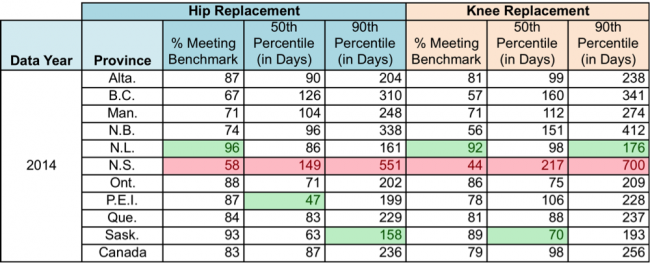
CIHI set a national waittime benchmark for both hips and knees of 182 days. Ninety percent of patients should be operated on within that time. In Nova Scotia last year, we hit that benchmark only 58 percent of the time for hips; 44 percent for knees. Ten percent waited more than 700 days.
The numbers put Nova Scotia dead last among Canadian provinces. Newfoundland manages to hit CIHI’s benchmark numbers 96 percent of the time for hips, 92 percent for knees.
Nova Scotia health ministers can get away with this because, unlike bypasses, a delayed joint replacement doesn’t produce deaths. Only pain. Nova Scotians waiting for joint replacement are in severe pain around the clock—whether sitting, walking, or trying to sleep.
(The government shows far more interest in controlling pain medication than controlling pain. If you’ve received a physician’s prescription for a narcotic pain reliever, the NS Prescription Monitoring Board is monitoring you and your doctor.)
Imagine if Nova Scotia managed gasoline sales the way it manages joint replacements.
“Fill her up with regular, please.”
“Ah, I can put you on the waiting list.”
“The waiting list? Is gasoline rationed?”
“Absolutely not. But there is a waiting list for a fill-up.”
“How long a wait?”
“It depends, sir. It can be up to 700 days.”
“Depends on what? How is my waittime determined?”
“I can’t say, sir. They don’t tell us that.”
Just how bad is Nova Scotia’s performance on joint replacement? The worst in Canada. The chart below compares Nova Scotia’s CIHI data with the other provinces. The red field represents Nova Scotia’s bush-league performance last year. Green cells denote the top performers. Check out the dismal discrepancies.
 Source: Canadian Institute for Health Information, 2014 Waittimes, http://waittimes.cihi.ca
The 50th percentile means half of all patients had to wait longer than the number shown. The 90th percentile means 10% had to wait longer than the number shown. CIHI defines waittime as “the number of days a patient waited, from the booking date to the date the patient received a planned total (joint) replacement. Booking date is when the patient and the appropriate physician agree to a service, and the patient is ready to receive it.” But that’s not the only wait. It can take months to reach that doctor-patient agreement—the average for Halifax is 140 days.
CIHI created benchmarks to improve performance, but Nova Scotia has had a death grip on last place since at least 2008. In the intervening seven years, we ranked dead last in 35 of 42 performance data points. In other words, we’ve had 42 opportunities to be the worst in the country, and accomplished that distinction 35 times. [I’ll include a detailed chart after the jump.]
The Nova Scotia Government website lists 22 surgeons who did joint replacements last year, along with their average waittimes. The numbers show they performed a total of 1,446 joint replacements of both types in 2014. That breaks down to an average 1.4 per week, assuming a minimum of four weeks’ vacation. They also did 388 emergencies, which brings the number to 1.7 per week.
You have to wonder what they’re doing the rest of the week.
OK, obviously, surgeons assess patients before surgery, and follow up with patients afterwards. They may be doing other procedures. No one expects them to operate four times a day, five days a week, but given their extraordinary skill set and our cruel waittimes, surely orthopedic surgeons ought to be performing more than 1.7 joint replacements per week.
Health Department flacks will surely have an explanation. “The issue is complex... We're working hard to acquire more resources... We are developing a strategy...” etc. But here’s a curious excerpt from an outfit called Timely Medical Alternatives, which books operations for Canadians in the U.S. (hip replacement = circa $20k CAD).
Source: Canadian Institute for Health Information, 2014 Waittimes, http://waittimes.cihi.ca
The 50th percentile means half of all patients had to wait longer than the number shown. The 90th percentile means 10% had to wait longer than the number shown. CIHI defines waittime as “the number of days a patient waited, from the booking date to the date the patient received a planned total (joint) replacement. Booking date is when the patient and the appropriate physician agree to a service, and the patient is ready to receive it.” But that’s not the only wait. It can take months to reach that doctor-patient agreement—the average for Halifax is 140 days.
CIHI created benchmarks to improve performance, but Nova Scotia has had a death grip on last place since at least 2008. In the intervening seven years, we ranked dead last in 35 of 42 performance data points. In other words, we’ve had 42 opportunities to be the worst in the country, and accomplished that distinction 35 times. [I’ll include a detailed chart after the jump.]
The Nova Scotia Government website lists 22 surgeons who did joint replacements last year, along with their average waittimes. The numbers show they performed a total of 1,446 joint replacements of both types in 2014. That breaks down to an average 1.4 per week, assuming a minimum of four weeks’ vacation. They also did 388 emergencies, which brings the number to 1.7 per week.
You have to wonder what they’re doing the rest of the week.
OK, obviously, surgeons assess patients before surgery, and follow up with patients afterwards. They may be doing other procedures. No one expects them to operate four times a day, five days a week, but given their extraordinary skill set and our cruel waittimes, surely orthopedic surgeons ought to be performing more than 1.7 joint replacements per week.
Health Department flacks will surely have an explanation. “The issue is complex... We're working hard to acquire more resources... We are developing a strategy...” etc. But here’s a curious excerpt from an outfit called Timely Medical Alternatives, which books operations for Canadians in the U.S. (hip replacement = circa $20k CAD).
By the way, many Canadian surgeons have told us how they envy their colleagues in the U.S. who are able to operate several days per week rather than only one day, as in Canada. The more a surgeon operates, the better able the surgeon is to hone his/her skills.
Call the statement self-serving if you will, but it’s odd how the claim lines up with my back-of-the-envelope calculation.
Last year, Health Minister Leo Glavine promised $4.2 million to begin addressing the problem. But that year’s Auditor-General’s report [pdf] says:
Recent estimates note approximately $35 million is needed to start completing 90% of hip and knee replacements within the six-month benchmark reported by [CIHI]. Once this benchmark is achieved, an estimated $7.7 million is needed annually to maintain a six-month wait moving forward.
So Glavine is providing barely 10 percent of the funds needed to achieve the 90 percent benchmark.
There are a lot of bright people in NS. We should be able to manage this. If we can’t, then it’s time to start firing managers and forcing unions to re-certify. And don’t blame the rank and file; these things always come down to the people who get the big bucks.
Newfoundland has had a strategy [pdf] in place since 2012. Maybe that’s the key. But read this related excerpt from the A-G’s report and then estimate the odds of Nova Scotia pulling off something similar:
Operating room coordination: Historically, operating room utilization was considered the responsibility of the district health authorities. In 2012, the Department recognized it has a Provincial role in trying to coordinate clinical services planning (including surgery) and the Provincial Clinical Services Planning Steering Committee was formed. Clinical services planning involves designing a Provincial approach to care including where people can access services, such as surgical procedures. Management decided to focus on orthopaedic surgeries initially since the Orthopaedic Working Group had been formed and was developing a five-year plan. However, there is still no overall framework for surgical clinical services planning. Clinical services planning will be fundamental for ensuring operating room resources are optimized with a focus on surgical priorities Province-wide.
Recommendation 4.9: The Department of Health and Wellness should develop a clinical services planning framework for surgery that determines which services will be offered in each location.
Department of Health and Wellness Response: The Department of Health and Wellness agrees with this recommendation. The Perioperative Advisory Committee will assist in providing leadership and will work with the new provincial health authority structure to determine a clinical plan for surgical services. [Source: Nova Scotia Office of the Auditor General: December 2014 Report, Chapter 4: Health and Wellness — Surgical Waitlist and Operating Room Utilization [pdf]; Weasel word emphasis: mine.]
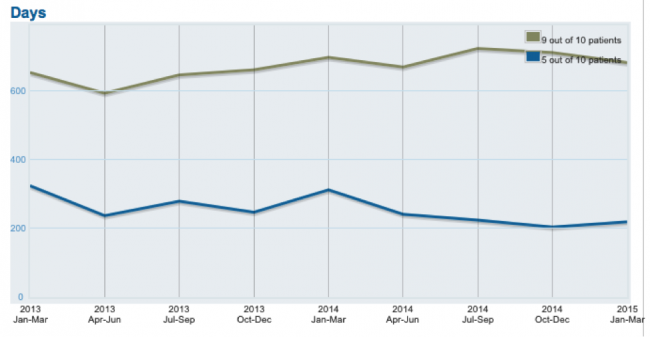
Once again, the system is protecting the status quo. Don’t believe me? Have a look below at the “progress” the department made in knee replacement over the last two years:
Source: http://waittimes.novascotia.ca/procedure/knee-replacement-first-side-only
Hip replacements can be obtained in the U.S. for between $10k and $20k. Why doesn’t Nova Scotia negotiate with nearby U.S. states to take our overflow? Why doesn’t the province allow Dartmouth’s famously efficient Scotia Surgery Inc. to expand its services? Medicare is about having a single-payer, not who receives the payment.
I expect many retired Nova Scotians are already borrowing or dipping into savings to pay for surgery in the U.S, which can take as little as two weeks.
Not much of a reward for a lifetime of paying taxes.
Data-lovers, see more after the jump.
08 June, 2015
