Contrarian reader Colin May writes : Do you know anyone who believed the three promises made by DD and his colleagues ? Did you believe they would be able to keep the ERs open ?  Everyone in the health business knew it was BS. Voters just wanted rid of Rodney, they cared less about reality. The less said about the media the better. Looks like Premier McNeil in four years, about the only bright light in the Canadian Liberal firmament. Stan Jones adds: While I tend to agree with the recommendations in the report, I wonder if it isn't true that Dexter and Steele knew...

This morning, Contrarian observed that Darrell Dexter had to have known he could not keep the three main promises of his June campaign: no deficit, no tax increases, and no program cuts. Sure enough, the premier jettisoned all three promises at a news conference this morning, and lamely tried to ascribe his about face to new information: But there are economic realities that we are faced with today that we did not know six* months ago. and: We have information now that no one had six months ago. Do tell. What new information is that? The Economic Advisory Panel report offers little that wasn't known long...

Contrarian is working his way through the Economic Review Panel's 95-page report. At first blush, it seems a sensible document, offering a balanced approach to navigating the economic mess the MacDonald government left us in. Premier Darrell Dexter choose wisely in selecting Donald Savoie, Elizabeth Beale, Tim O'Neil, and Lars Osberg to carry out the review. All are respected, progressive, and fair-minded. But before we get too deep into discussing the pros and cons of their recommendations, something needs to be said: Darrell Dexter campaigned on a triple-barreled promise: not to run a deficit; not to raise taxes; and not to cut programs....

[caption id="attachment_2847" align="alignright" width="350" caption="Inter-provincial power grid diagram shows the startling degree to which Nova Scotia is an energy island. This is a big obstacle to the development of local renewable energy supplies like wind and tidal, which are intermittent and therefore require robust interconnection with nearby power porducers and users. The Hydro Quebecwick deal means that any increase in our connectivity with the rest of the world will be at the mercy of the new monopoly owner of the grid, the Government of Quebec."][/caption] Premiers Shawn Graham (NB) and Jean Charest (QC) have unveiled the details of the Hydro Quebecwick...

This promises to be a continuing Contrarian topic, but I will flag it briefly: NB Power's apparently imminent sale to Hydro Quebec represents a tectonic shift in Nova Scotia's energy options. I mention this because, as is typical, the national news media seem to view the story as just another installment in Newfoundland Premier Danny Williams's (to them) clownish battles with central Canada. Such a view is as witless as it is patronizing. The sale poses huge problems for Nova Scotia and PEI, as well as Newfoundland. If Quebec can use its windfall profits from Joey Smallwood's disastrous 1969 deal on Upper...

We can't say whether Liberal leader Stephen McNeil read this particular Contrarian entry, but he did both the right thing and the smart thing in helping astonished New Democrats speed passage of political financing reform through the house in a single day. It's the smart thing, because McNeil couldn't prevent passage of the new law, so why encourage days of debate focusing on past Liberal wrongdoing? It's the right thing, because no party should enjoy a permanent finger on the political scale based on a 40-year-old shakedown racket. McNeil explained it this way:It was my direction—and I take full responsibility—that...

I've criticized the NDP's carbon subsidy (here, here, and here,), but I understand the value of keeping campaign promises, even dumb ones. In my contrary view, public cynicism about politicians is so deep, it threatens to destroy the minimal level of public trust democracy needs to survive. This may be why the Tories and the Parliamentary Press Gallery have been so successful at drumming up absurd faux-outrage at the prospect of a fall election. So even as two of the Dexter government's promises (keeping all rural emergency rooms open and using tax rebates to encourage electricity consumption) make me shudder, I...

Dexter at the Pride Parade - mediumSeven weeks after electing Atlantic Canada's first NDP government, Nova Scotians have seen little if anything in the way of policy initiatives from Dexter and Co. Senior civil servants, however, seem practically giddy with delight at the NDP's methodical approach to policy. "They actually read the briefing books," exclaimed one official, referring to the massive tomes each department prepares detailing the policy issues an incoming minister will face. "They read them, and they ask intelligent questions. They are really into policy."
Is Peter MacKay channelling John Buchanan? Is Stephen Harper keen to cultivate a second Danny Williams in Atlantic Canada? Those are two possible explanations of the Harper Government's mean-spirited, post-election reversal of its commitment to help fund the $40-million, four-rink arena planned for Bedford. The Conservative about-face presents an early test for Darrell Dexter's Government. Last month, the feds assured HRM officials that the project was on track to receive $15 million in infrastructure funding from Ottawa's stimulus program. The NDP Government likewise committed $15 million, and HRM was to finance the remainder. Last Friday, Ottawa abruptly informed city hall it no longer...

cabinet - 2 - cropped - medium
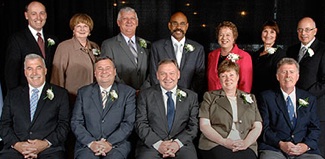
As Nova Scotia’s new government begins its third week in office, a critical early mistake is coming into focus: Darrell Dexter’s 12-member cabinet is too small for the job at hand. Cabinet selection inevitably requires consideration of gender, ethnicity, and geography: Women must take a prominent place; there must seats for Cape Breton, northern Nova Scotia, the south shore, and the valley; Metro MLAs must not appear to dominate. Legitimate political and cultural considerations of this sort do not necessarily trump such factors as experience and merit, but they compete with them. That leads to problems.