A friend who became a citizen Friday after living in Canada for 30 years sends this email: Almost 24 hours as a Canadian, and this has what's been happening: Dreamed last night that cricket was being played with a puck, eh! Have a craving this morning for a Double, Double, eh! I keep slowing down for pedestrians, eh! My first practice swing for golf this morning was left-handed, eh! When I received my usual list of orders last night from the "trouble and strife," I actually thought about complying, eh! What's going on????...

Best Buy has apparently relented on its threat to fire smartphone salesman Brian Maupin, 25, for his parody of an Apple fangirl rebuffing a salesman's efforts to sell her an HTC Evo instead of the out-of-stock iPhone G4. Warning: major profanity alert. Neither the original animated film, nor Maupin's rebuttal parody, in which an Evo-owner tries to get his phone fixed at an Apple store, so much as mentions Best Buy — but they do have nearly four million views between them, which may have persuaded the giant retail chain to reconsider the PR wisdom of humour-challenged personnel management. Hat tip: Leo Laporte....

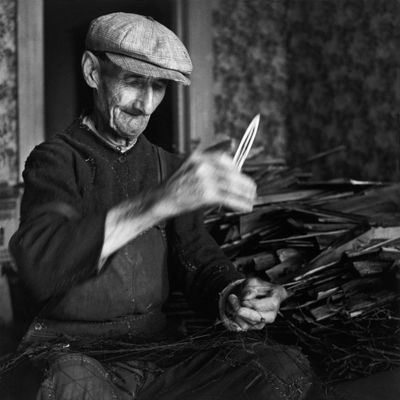
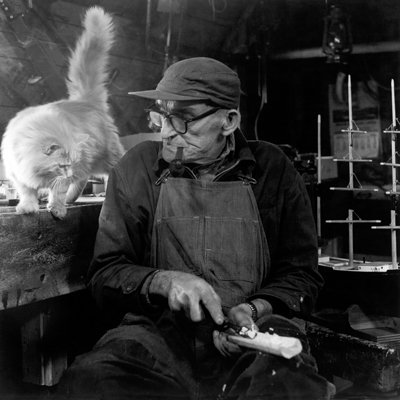
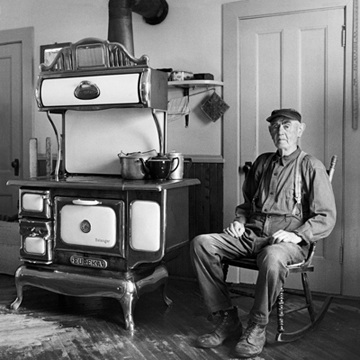
Peter Barss, at yesterday's opening of his rescued Images of Lunenburg County at the Anderson Gallery:
As you look at these pictures and read the text panels from the book I imagine you’ll be asking yourselves the same question that has perplexed me for years: how did these men survive... without Wal-Mart? Images-Barss-040Right after Myra and I were married we spent a few nights in the West Ironbound lighthouse with our friends Ingram and Lynn Wolf, the light keepers on the island. One evening Ingram set out to rake up some grass but couldn’t find his rake. So he made one. Drilled some holes in a narrow board, whittled wooden pegs for the teeth, and walked into the woods to cut a sapling for a handle. Ingram had the grass raked up before the sun set. That memory has remained with me as emblematic of the self-sufficiency and resourcefulness of the people represented in this exhibit, If I had needed a rake it would never have occurred to me that I could make one. I would have headed directly to the hardware store. These men could fix anything that went wrong with the engines in their boats with nothing more than a screw driver and a pair of pliers, they navigated through fog as thick as pea soup, and they could tell you what the weather would be in coming days more accurately than the forecasters of today who seem to believe that staring at computer screens will give them more information than stepping outside and learning what nature has to tell them. These men lived at a time when communities were relatively isolated, families were closer and people had more time for each other. Neighbors depended on neighbors in good times and bad times. There were community dances and parties and when men were lost at sea --which happened all too frequently--the entire village grieved with the family. They were not rich men and they didn’t own a lot of stuff. But they were only poor in an economic sense. One man told me “I remember back... there was nice feelings in them times. We had nothin’... but you was a millionaire.” It’s easy to romanticize the era this exhibit portrays. No one wants to go back to those days... but maybe we should look back and think about what we have lost.
The show is up until August 4. After the jump, Peter describes the work a Halifax design shop put in restoring the images, the negatives for which had been lost in a house fire a quarter century ago:
Images-Barss-039You should consider taking in an opening from 3-6 p.m., at the Anderson Gallery, 160 Montague St., Lunenburg, of reclaimed images from Peter Barss's classic 1973 collection, Images of Lunenburg County. I'm prejudiced. Peter (who doesn't think much of my iPhone snapshots of sunsets) is a delightful eccentric, a former relative, and a dear friend with a knack for producing images that enliven and deepen our understanding of subjects we thought we already understood. Images combined Peter's photos of sail-era fishermen with oral history about fishing in the first half of the 20th century. Fourteen years after the book's publication,  a house fire destroyed all his prints and negatives. Images (Barss) 020Fortunately, the Nova Scotia Museum had purchased a complete set of the photos, which Craig Yorke of Image House has brought back to life, using advanced photographic techniques. The Anderson Gallery will display 40 of the black-and-white prints through August 4. Everyone is welcome at Saturday's opening. Herald arts reporter Elissa Bernard has a nice tee-up for the show here. See more images here. After the jump, Peter's artist's statement for the exhibit, a lovely account of how the photos came to be, and a refreshing break from the artspeak that often characterizes this class of prose.
Contrarian friend and New Waterford video artist Ashley McKenzie, now serving temporary exile in Halifax, has put some of her wonderful still photos on line. McKenzie previously recorded the demolition of Sydney's Vogue Theatre in this clever video....

The scale is deceptive. This is not the ordinary crab we're used to, but a giant Japanese spider crab (Macrocheira kaempferi), whose leg span (3.8 meters or 12.5 feet) and weight (up to 19 kg. or 41 lb.) make it the largest arthropod in the world. This time-lapse video was shot over a 6-hour period. Hat tip: Enoshima Aquarium, Fujisawa, Japan, via Daily Dish....

Jane Kansas takes time out from her walk to mount the simplest, most easily understood defence I've heard of a women's right to choose face coverings like the niqab and the burka. Money quote: At the beaches of Nice, Cannes and Saint-Jean-Cap-Ferrat most women were young and slim and topless. In all the cafes, women wore only tiny bikini bras and sarongs, or simply sat and scarfed down their Croque Madames and Ricards in their bikinis. It was what was done. I sure didn’t. I come from a place where women do not sit in restaurants in their bikinis. I would be...

Oh, not that Rolling Stone article. One you weren't expecting. Money quote: Seeger switched to a 12-string guitar and began a hymn-like finger-picked version of "Somewhere Over the Rainbow." He told the story behind the classic Wizard of Oz track, recounting how lyricist Yip Harburg and composer Harold Arlen held a successful two-man protest to get the studio to include the song in the film. Seeger looked up at the ceiling and apologized to the deceased Harburg for having to change the lyric "Why can't I" to "Why can't you and I?" and explained his logic: "If I'd been there...

Aside from a small issue of geography, reader Ivan Smith says the Globe and Mail's take-out on racism in Nova Scotia, got it right. The popular notion that racism has disappeared from Nova Scotia is just as wrong as that geography. Racism is still here. Not as bad as it was in the 1960s or even the 1980s, but we still have a long way to go. How many Nova Scotians know that there were black slaves here? Smith recommends Simon Schama's Rough Crossings, a book and subsequent film depicting the treatment of blacks in Nova Scotia in the 1780s, available...

Warm-up: England vs. USA. our friend David appears to have scored a ticket. [Update]One Contrarian reader doesn't like the horns: Dear Sepp Blatter, Day 2 and I am happy to say that the sound level from the mics catching those damned horns has been dialed down a little by the broadcasters. It is the World Cup not the South Africa Cup. I want to hear supporters from around the world singing, chanting, dancing, booing, hissing, whistleing, banging drums (not continuously), lauging, moaning, oohing and aahing. Stuff your 'cultural' BS as the reason for inflicting a steady droning noise on billions of viewers around...