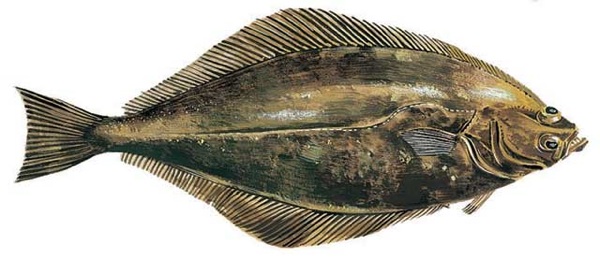
Halibut - large Contrarian reader LH who fished halibut in Alaska for eight years, the very place where Greg Easterbrook said Individual Transferable Quotas have created a sustainable fishery producing top quality fish. He writes:
Quotes, yes, definitely; Transferable, absolutely NO! Clearwater or some other fishing company would own them all either by outright purchase or yearly leasing. ITQ’s are the reason we have arm chair millionaires. [The quota owner] sits in his chair and collects $15,000 or more while someone else catches the fish. The money is in the paper not the fish... The most successfully managed fishery in the world is the Canadian lobster fishery. The resource is in good shape. One of the reasons: if you are licensed to catch it, then it is you who has to do so, full stop. Other factors are, of course, protection of the species by size, sex, harvest effort, and trap limits.
Ah, but some would say the Maritimes lobster industry represents an informal application of property rights to the fishery. In many lobster grounds, fishermen occupy individual “berths,” where they enjoy an exclusive right to set traps. These property rights have no basis in law, but they are rigidly enforced by community custom.
Crest Halifax has a thoughtful discussion about the problem of low frequency noise from windmills, and the illness some say it causes.
Of course it is possible that those reporting the symptoms of Wind Turbine Syndrome are more sensitive to sound and vibration than most people, or even than detection instruments. It’s also possible that other factors are at work. Could the illness be, to some extent, psychosomatic in nature?

Greg Easterbrook thinks Individual Transferable Quotas (ITQs) hold the key to saving vanishing fish stocks. He makes the case in the current Atlantic, part of an article called 15 Ways to Fix the World. After describing a delicious halibut dinner in Girdwood, Alaska, he writes: Good restaurant? Yes, but even better fishery management. About a decade ago, the Alaskan halibut catch was switched from a system of “catch all you can” in a very short period, to a system of tradeable permits. Now halibut season does not happen over a few chaotic days marred by colliding boats and overlapping lines, followed...

In his latest Herald column, the normally estimable Ralph Surette drinks the feed-in tariff Kool-Aid. Moneyquote:
Check out how they’re doing it in Ontario and other out-front jurisdictions, where "feed-in" laws or "standard offer contracts" are in effect — in which the utility is required to take power produced by entrepreneurs at a fixed rate, no haggling. Wherever it’s been tried, there’s been an explosion of energy entrepreneurship and new jobs. The [Nova Scotia Power] system of calling tenders one project at a time didn’t work elsewhere, and it hasn’t worked here.
Ralph makes a few good points in the column, but these two paragraphs contain more foolishness than enough.
ralph_surrette-cropped-small
Ontario passed a bill authorizing the Minister of Energy to permit the use of feed-in tariffs just six weeks ago, and the regulations haven't been written yet. So it hasn't produced "an explosion" of anything yet, except perhaps hyped expectations among the uncompetitive producers who have been pushing for such a law here. As for other jurisdictions, in North America, Ontario is it: the first state, province, or country to pass a feed-in tariff law. As for tendered contracts not working, that will come as news to generations of good governance experts. Elsewhere in the same column, Ralph rightly criticizes NSP's attempt to win Utility and Review Board approval for an untendered biomass project.
green-watsonThe Green Party of Nova Scotia, and riding associations for the Greens and two other recognized parties, face imminent deregistration under the Elections Act for failing to publish audited financial statements for the last fiscal year as required by law. Dana Philip Doiron, communications director for Elections Nova Scotia, confirmed that Chief Electoral Officer Christine McCulloch will file her annual report under the Members and Public Employees Disclosure Act (MPED) Tuesday, and deregistration could follow shortly thereafter. "Sometimes [the report's release is] a ho-hum event, and Frank is the only one interested," Doiron said "In this particular case the report will be looking at compliance for reporting, and that report will be interesting."
[caption id="attachment_777" align="alignright" width="150" caption="Dr. Chris Milburn"]Dr. Chris Milburn[/caption] What's disquieting about our New Democratic Party government-in-waiting is the same thing that's been disturbing about Nova Scotia for decades: a lack of compelling leadership. It's not simply that our once-upon-a-time socialists have moved to the dead center of the road. Contrarian is OK with that. It's Darrell Dexter's meticulous avoidance of anything that might challenge voters in any way. The NDP knew that to get elected, they would have to win seats in rural Nova Scotia. They took polls and conducted focus groups, and discovered that rural Nova Scotians are upset about emergency room closures. So the NDP promised to end those closures, even though every thoughtful observer knows that doing so would be a wasteful diversion of scarce health care dollars. Among other things, it will make recruitment of physicians to rural areas more difficult, not easier. Why would a fully trained physician want to sit in an emergency room all night to treat one or two patients?

crest-logoCREST Halifax has uploaded  a video of last Tuesday's all-party debate on environmental issues, which was sponsored by the Ecology Action Centre. The video of the two-hour debate is divided into 10 segments. Unfortunately, they are not annotated, so contrarian can't point you to the particular segments where Howard Epstein tried to defend the NDP's plan to subsidize coal-fired electricity, the many places where Green Party deputy leader Brendan MacNeill oversold the concept of feed-in tariffs for wind power, and the spot where the NDP, the Greens, and the Liberals all but nixed the proposed Donkin coal mine.
fallows-roof-1s Two questions about this photo from an entry in Atlantic Magazine writer James Fallows's wonderful blog:
  1. Do you notice anything unusual about this cityscape?
  2. Can you name the country in which this photo was taken?
Answers after the break. 
NDP leader Darrell Dexter today promised to provide 1,000 home insulation grants for low to modest income households. This is a much better idea than Dexter's plan to subsidize carbon production by removing the provincial share of HST from home electricity bills. Here's why:
  • Insulation grants will cut the province's CO2 emissions, while the carbon subsidy will increase them.
  • Insulation grants will target homeowners most in need, while the carbon subsidy will go disproportionately to the well-off, because they use more electricity.
  • Insulation grants will create jobs for carpenters, plumbers, electricians, and local businesses, while the carbon subsidy will have little or no employment impact.
  • Insulation grants will produce permanent reductions in home heating costs, while savings from the carbon subsidy will last only as long as the tax break is in place.